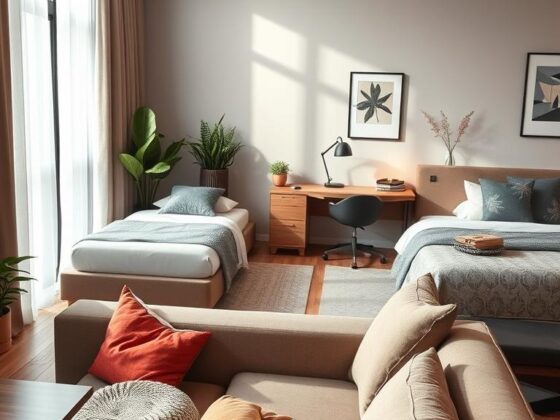
Can a tight room feel like a calm, generous retreat instead of a cramped box? I ask that because I treat every small bedroom like a puzzle where each choice must earn its keep.
I’ll share bedroom ideas I use with clients to make spaces feel deliberate and restful. I focus on flow, realistic scale, and layered texture. Low bed frames and bare canopy frames lift the ceiling visually. An extended headboard can widen the field without clutter.
I favor Roman shades and wall sconces to save surface real estate. A full-length mirror on a door can make space read larger. Deeper hues can cocoon a room with limited light, while tonal accents keep the mood easy.
My goal is simple: suggest practical, weekend-friendly fixes and where to invest for better sleep and calm at home. Follow along and you’ll learn how to make space feel intentional, soothing, and adaptable.
Key Takeaways
- Prioritize flow: choose essentials and scale first.
- Use low profiles: beds and bare canopies lift the ceiling.
- Save surfaces: wall sconces and door-mounted mirrors free space.
- Color with care: deeper hues can cocoon without shrinking.
- Practical swaps: Roman shades and smart bed choices make rooms work harder.
Start With a Smart Layout: Plan Flow, Scale, and Purpose
A smart layout begins with a quick, scaled sketch of the room—feet as inches. I do this on paper or with a simple app so door swings, closet access, and walking paths are obvious before a single piece moves.
Map the room and protect movement
Mark the lanes you must keep clear: closet, bathroom threshold, or balcony. Protect that floor space first. You’ll see immediately where a bed or chair will pinch circulation.
Right-size the bed and night surfaces
The biggest misstep is a mattress that’s too large. It forces tiny night tables that don’t function. I prefer a properly scaled bed with usable surfaces over a crowded, oversized option.
Decide what each space must do
Choose essentials up front: storage, work, or lounge. One multitask piece can solve two needs—a desk that doubles as a nightstand or wall-mounted shelves to free floor area.
“Draw the plan, tape the footprint, then live in the sketch for a day.”
- Scaled plan first: see door swings and access before buying.
- Place the bed to support circulation, not to center for symmetry.
- Float fewer pieces: pick multifunction items to save space and keep flow.
When you start with purpose, the room feels calm and useful—like a small bedroom that truly works for your home.
Decorating Small Bedrooms: Core Principles That Make Space Feel Bigger
Cutting visual noise is the fastest way to let a compact room breathe. I start by clearing tops and editing what sits on surfaces. Clean sightlines let light travel and the room read larger.
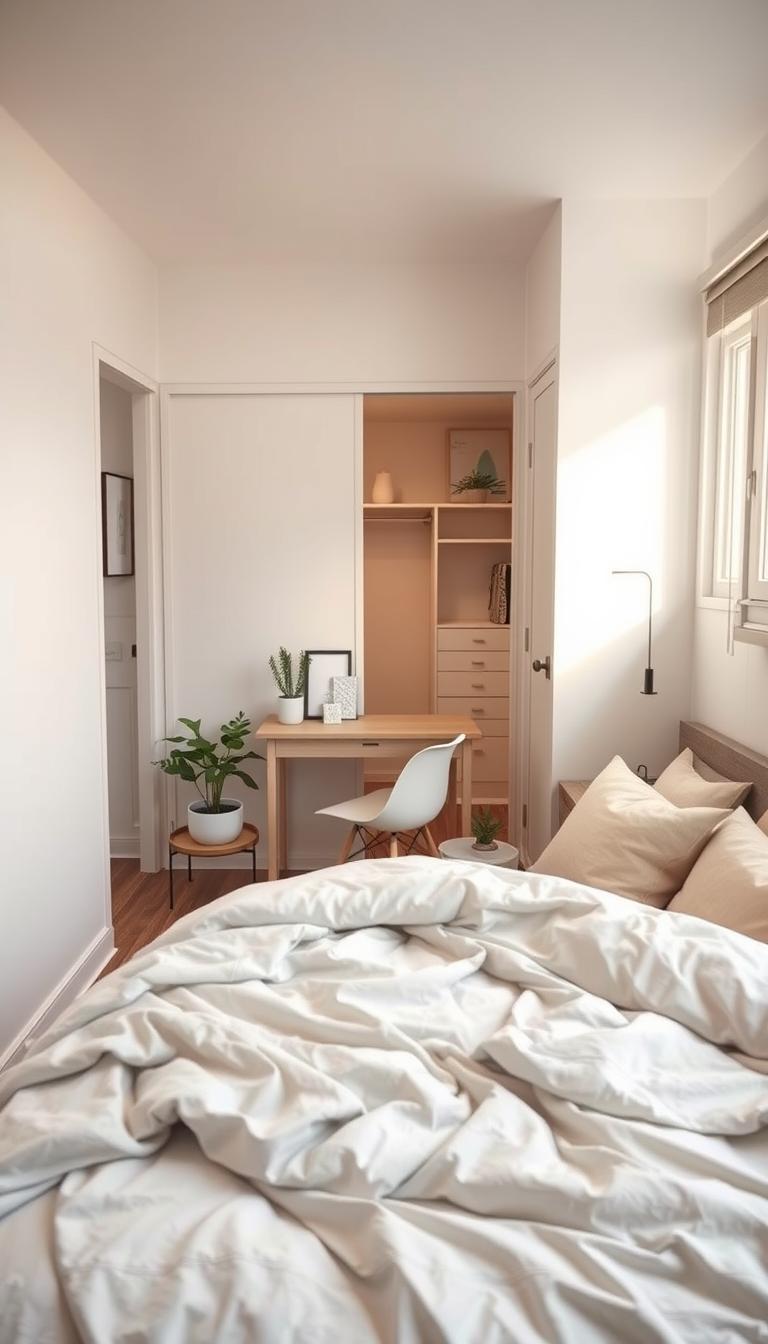
Edit visual clutter and keep surfaces clear
I treat surfaces like runway space—clear tops calm your eye and instantly make the space feel bigger and more restful.
Use trays for nightly essentials. Rotate a single sculpture or a small art group seasonally so ornaments don’t pile up.
Choose fewer, multifunctional furniture pieces
Pick items that pull double duty: a desk that serves as a nightstand or a bench with storage. Wall-mount what you can—sconces, floating shelves, or a narrow shelf-vanity free the floor and let shadows open the room.
- Fewer better pieces: each one should earn its footprint.
- Scale matters: avoid too-tiny rugs or undersized nightstands.
- Repeat finishes: a rhythm of wood, metal, or fabric makes things read as a family.
“If a piece doesn’t serve two roles, it probably doesn’t earn its spot.”
Choose the Right Bed Frame: Low Profiles, Canopies, and California King Tips
The bed you pick does more than hold a mattress—it shapes sightlines and scale.
I favor low bed frames in compact rooms because they lift the eye line. Suddenly the ceiling feels higher and the whole envelope breathes.
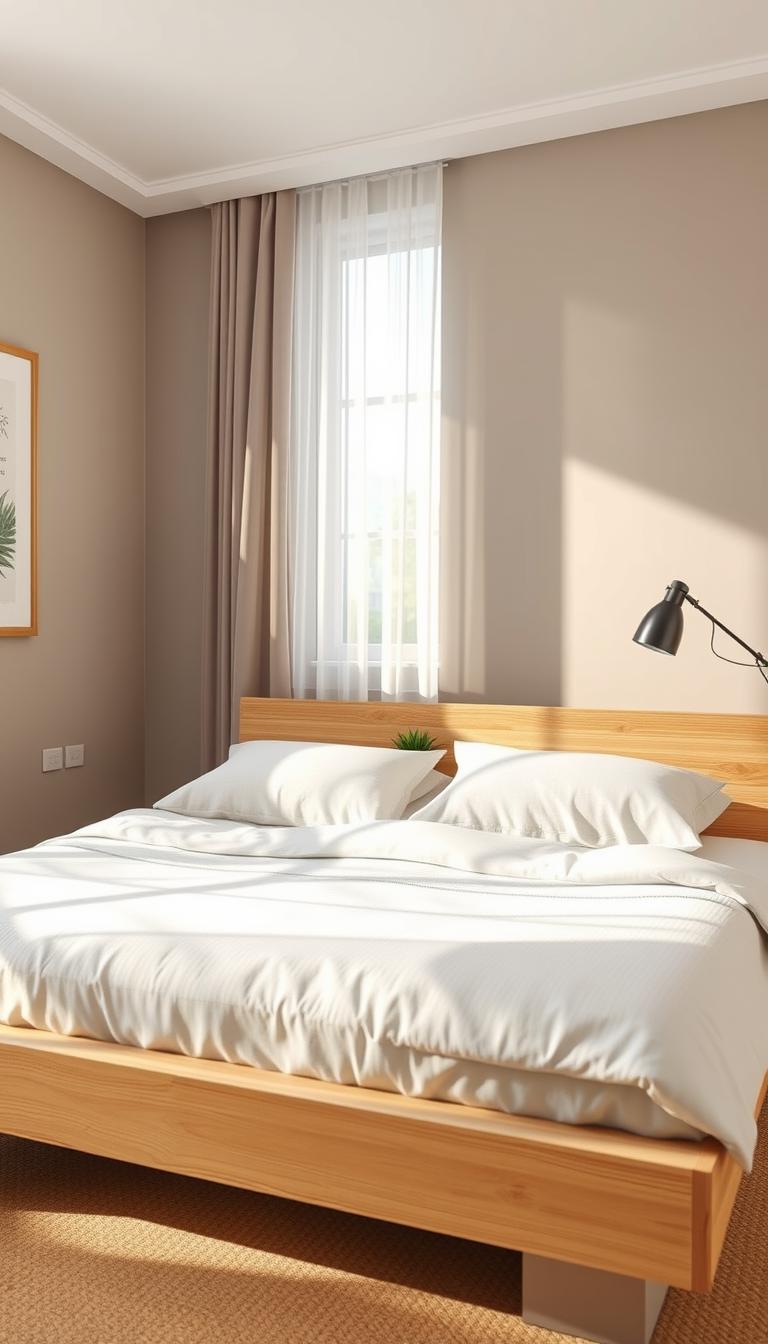
Low profiles to heighten the ceiling effect
Low profiles free visual headroom so a pendant or cornice can become the room’s focal point. Keep the headboard slim—channel-tufted or a shallow upholstered panel reads plush without depth.
Bare canopy frames to avoid heaviness
If you want a canopy, leave it bare. The vertical lines add architecture without the weight of drapery. It gives beds presence without shrinking the space.
California King for critical inches
When a king is nonnegotiable, consider a California King—it’s about four inches narrower than a standard King. That width often makes the difference between usable nightstands and none at all.
- Match finishes sparingly to avoid a heavy look.
- Skip footboards on tight footprints to preserve circulation.
- Check underclearance if you need hidden bins or low storage.
Maximize Multifunction: Murphy Beds, Daybeds, and Storage Beds
When a room must do two jobs, I favor furniture that folds, tucks, or stores to make life easier. These pieces win back floor area and calm the plan without hefty reno work.
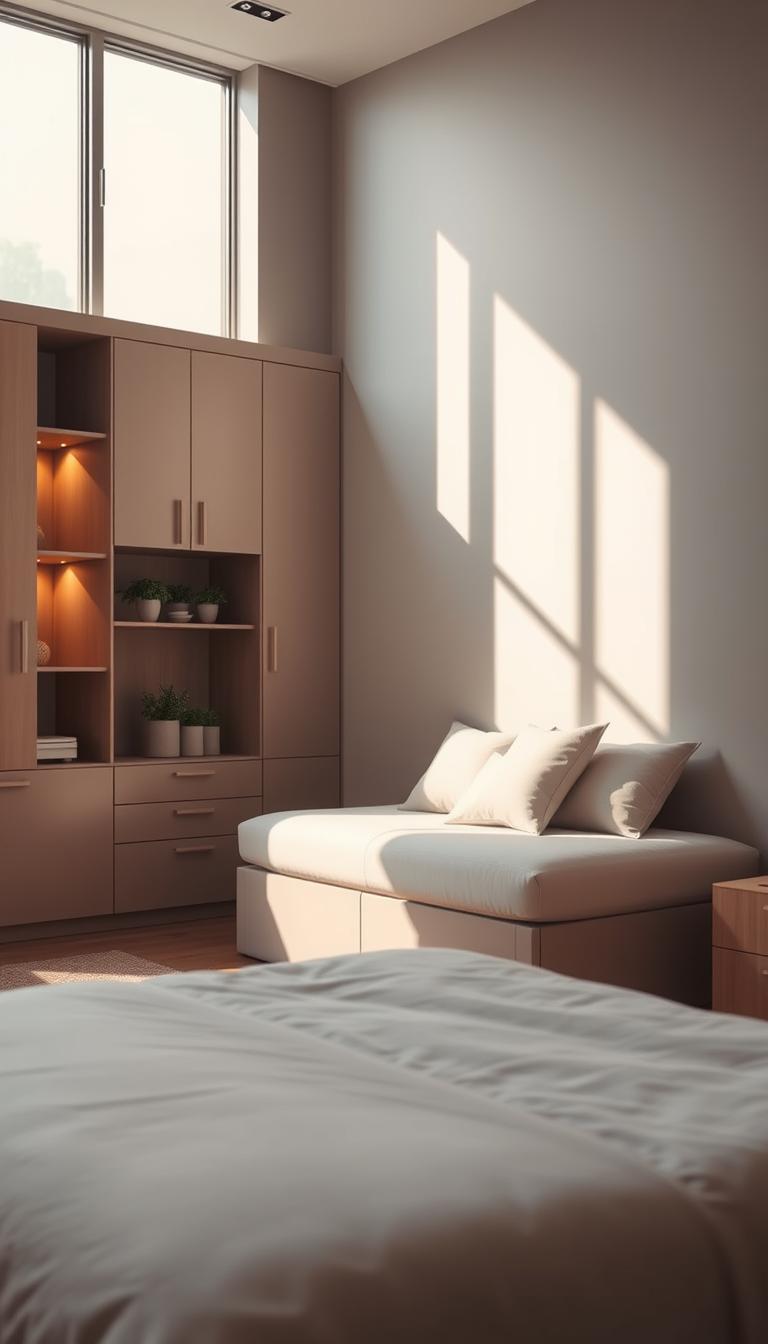
Murphy beds for rooms that double as home office or den
A Murphy bed hinged to an interior wall tucks away and frees square footage. Architect Michael K. Chen’s powder-blue example shows how a simple frame can change a day wall into a finished backdrop.
Daybeds that transition from seating to sleeping
Daybeds give lounge seating by day and a proper bed at night. Add bolsters for back support and a duvet that tucks away. They make studio-like flexibility feel intentional.
Pop-up and drawer storage beds to reclaim floor area
Pop-up storage beds—like West Elm’s Myla Pop-Up—lift vertically so you don’t need side clearance. Drawer bases work when aisle space exists; dedicate drawers to linens and off-season clothes.
- Look for integrated systems with shelves or a fold-down table to consolidate function.
- Style a Murphy wall with shallow shelving or art so the closed bed reads as a focal wall.
- Keep a slim rolling cart as a nightstand substitute for Murphy setups.
| Type | Best for | Storage | Clearance Needed |
|---|---|---|---|
| Murphy bed | Home office / multiuse room | Minimal built-in | Wall depth & ceiling height |
| Daybed | Lounge + guest sleep | Optional under-trundle | Front access for trundle |
| Pop-up storage bed | Very tight footprints | Large internal bins | Vertical lift only |
| Drawer base bed | Rooms with aisle room | Easy access drawers | Side clearance for drawers |
Built-Ins and Vertical Storage: Make Walls Work Harder
Built-ins let the walls do the heavy lifting so the floor can finally breathe. I favor inset shelving whenever possible—flush units free floor space and make circulation feel effortless.
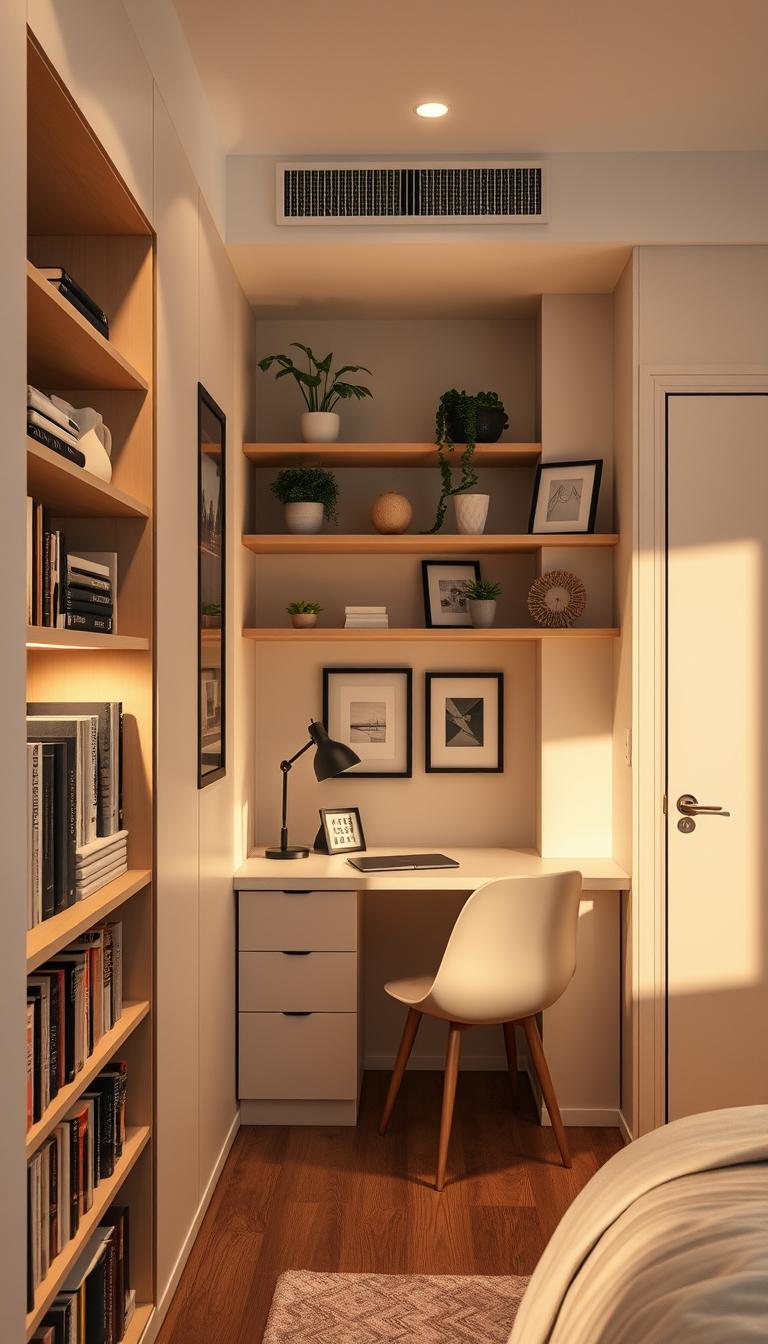
Don’t hide away the radiator. Fowlkes Studio folded a heat cover into an inset bookcase and it became a quiet feature instead of an eyesore.
Recessed shelves and radiator solutions
I recess storage to keep the plan tidy. A shallow, custom cover for a radiator makes a clean line and adds usable shelf depth.
High shelves for hidden storage
Mount shelves above eye level for items you don’t need daily. Keep everyday things on the lowest tier so the upper tiers act like hidden storage.
Over-bed bookcases and full-height pieces
Over-bed built-ins use wall space that would otherwise be wasted. Full-height wardrobes with shallow depths trade bulky dressers for slimmer storage and clear walking aisles.
- Adjustable shelving lets a system evolve with you.
- Color-match built-ins to the walls for a seamless plane, or contrast slightly to frame them.
- Plan for wall sconces near built-ins to save surfaces and spread light evenly.
“Let the vertical plane carry the load—it’s the easiest way to free up valuable floor space.”
| Built-In Type | Best Use | Impact on Floor Space |
|---|---|---|
| Recessed shelves | Books, bins, display | High—flush with wall |
| Inset bookcase (radiator cover) | Heat concealment + storage | Moderate—adds utility |
| Over-bed bookcase | Alcove storage | High—uses unused wall space |
| Full-height shallow wardrobe | Clothing + linens | High—replaces bulky dressers |
Create Multiuse Storage in Unexpected Places
Sneaking function into furniture is my favorite way to make a room work harder. It keeps the plan calm and gives every inch a purpose.
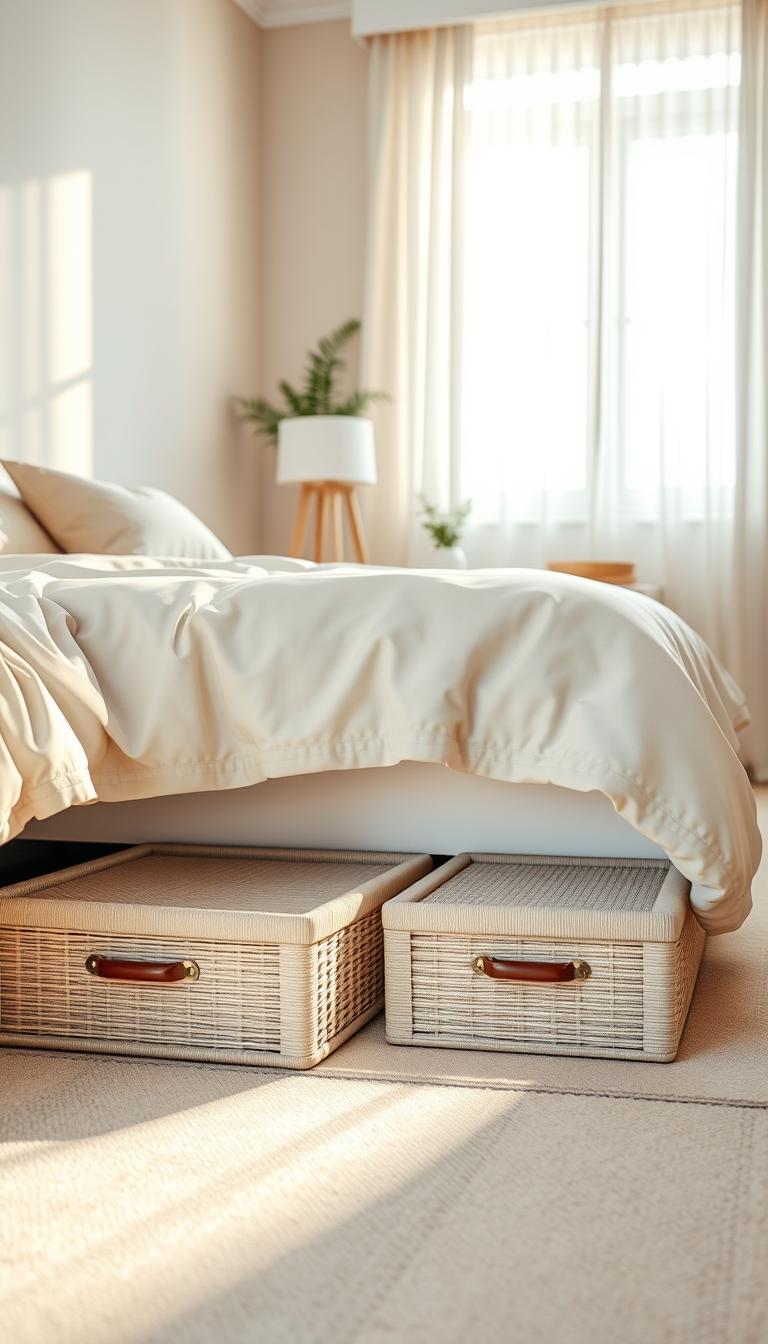
I love stair-drawers on bunks—those steps become usable storage without adding any footprint. Lift-top window benches and flat under-bed boxes tuck away off-season clothes and extra bedding.
Stair drawers, bench lids, and under-bed bins
Stair-drawers make a bunk practical for kids and adults alike. A bench with interior storage doubles as seating and a linen chest. For rentals, rolling under-bed bins are an easy, reversible way to gain area.
Nightstands with drawers and desks that double as tables
When both a desk and a nightstand won’t fit, pick a slim desk with drawers. It can serve as a workstation and bedside table in one tidy solution. Pair it with wall sconces to free the surface of lamps.
- Use drawer organizers so each inch works.
- Keep everyday items low for easy reach—especially in kids’ rooms.
- Label bins and baskets to reduce visual clutter and save time.
“A single well-chosen piece can replace two and make the whole room feel calmer.”
Light the Room in Layers: Sconces, Task Lights, and Ambient Glow
A well-planned light plan can expand perceived space and calm the senses. I aim for layers so the bedroom works for waking, working, and winding down.
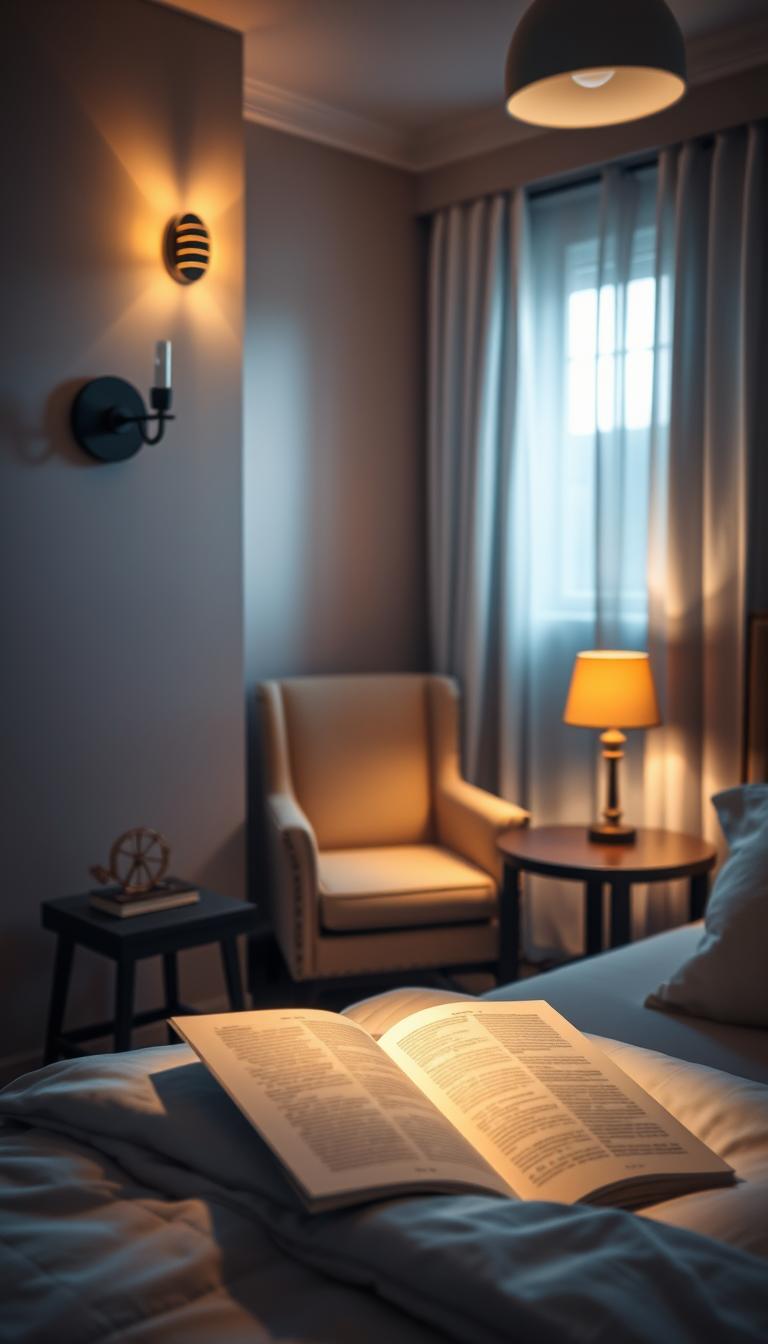
Wall sconces free up night tables and add soft ambiance
Wall sconces clear tops on night tables and free them for books or a glass of water. They also wash the wall, which visually stretches the perimeter of a room.
Battery-powered options when rewiring isn’t possible
If hardwiring is off the table, battery-powered fixtures are game-changers. Mount them where you need task glow—above a reading chair or beside the bed—no electrician required.
Mix overhead, bedside, and accent lighting for a calming mood
I design lighting like a soundtrack—ambient for mood, task for clarity, and accents for sparkle. Avoid relying on a single overhead; it flattens the space.
- Pair a soft-glow pendant with warm bedside fixtures and a tiny shelf LED.
- Dim everything; warm dimmers support sleep cycles and cozy reading.
- Choose fabric or frosted shades to diffuse glare and soften the gradient.
“Good layers of light make the last step into bed feel like a sigh.”
| Fixture | Best use | Install effort | Impact on tables |
|---|---|---|---|
| Hardwired wall sconce | Bedside & ambient wall wash | Medium (electrician) | Frees night tables |
| Battery sconce | Retrofit task light | Low (no wiring) | Clears surfaces easily |
| Soft-glow pendant | General ambient | Medium | Leaves tables for decor |
| LED strip / picture light | Accent & shelf lighting | Low | Doesn’t use table space |
Window Treatments That Save Space: Roman Shades and Tailored Drapery
How you dress the window changes how the whole room breathes. In my work, a compact treatment often makes the difference between clutter and calm.
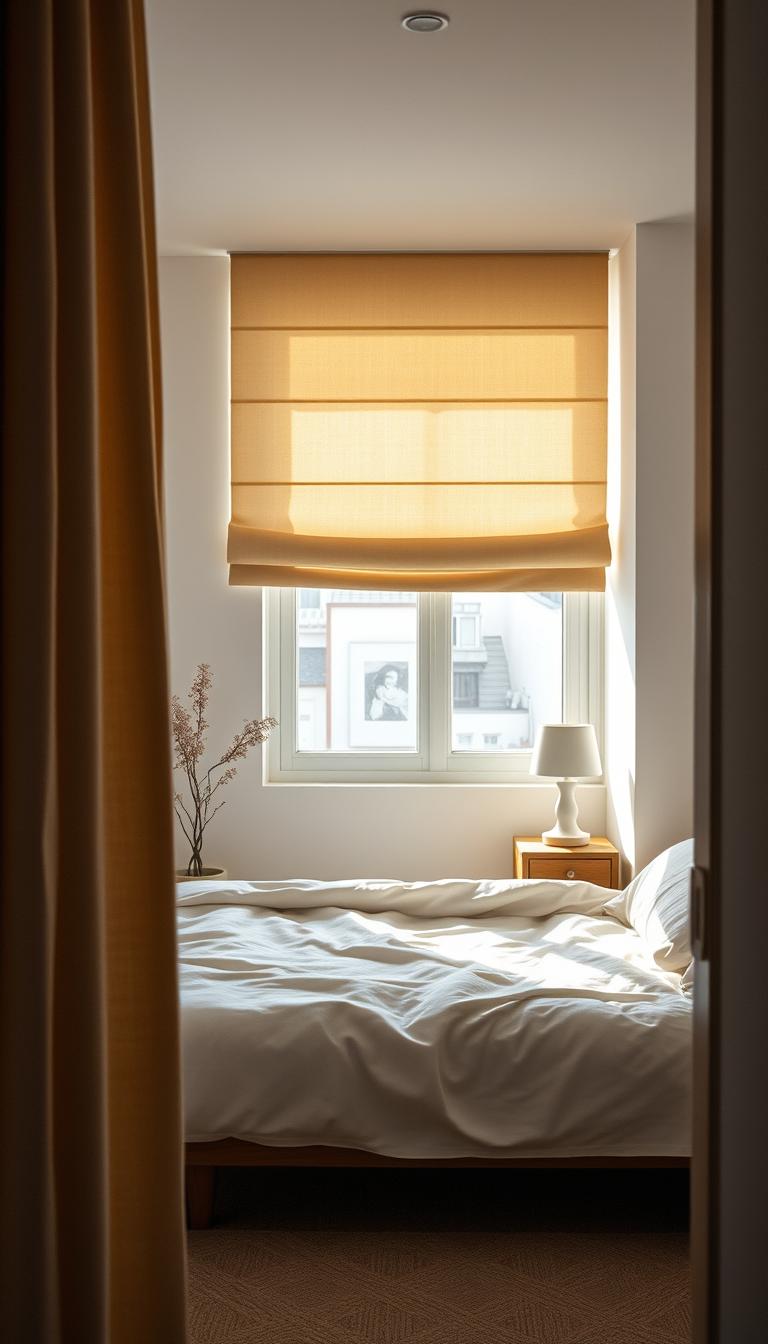
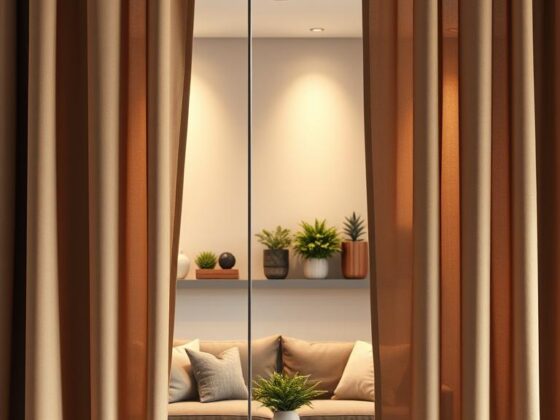
Roman shades are my go-to where there’s limited wall space. They fold neatly, stack high to welcome daylight, and avoid the bulk of full curtains. For a small bedroom, that tidy stack keeps sightlines open and gives usable wall space for hooks or art.
Roman shades for tight windows
Mount shades at or just below the ceiling line to elongate the walls. Choose light-filtering linings so daylight softens the room by day, and use blackout linings for sleep when needed.
Run drapery behind the bed for a cohesive backdrop
If the bed sits near a window, run tailored drapery behind the headboard to create a soft, continuous backdrop. Keep fabric tailored—no puddling—so the treatment reads as architecture, not clutter.
- Hardware: pick low-profile tracks or slim rods to reduce visual bulk.
- Operation: cordless or motorized options keep lines clean and add safety.
- Palette: match drapery tone to walls for a seamless plane or choose a subtle stripe to add gentle rhythm and style.
“Simple, fitted treatments free the floor and let the window be a feature, not a problem.”
| Treatment | Best for | Impact |
|---|---|---|
| Roman shade | Tight windows, minimal wall space | Neat stack; opens light; low visual bulk |
| Tailored drapery behind bed | Bed close to window | Creates cohesive backdrop; cocooning effect |
| Motorized shade | High windows or touchless needs | Clean lines; easy use; safer for kids |
Color and Pattern: Dark Palettes, Wallpaper, and Pattern-Drenching
Deep paint and a brave wallpaper can turn a compact room into a jewel-box retreat. I use color to set tone quickly, then balance it with scale and lighting so the result feels intentional, not cramped.
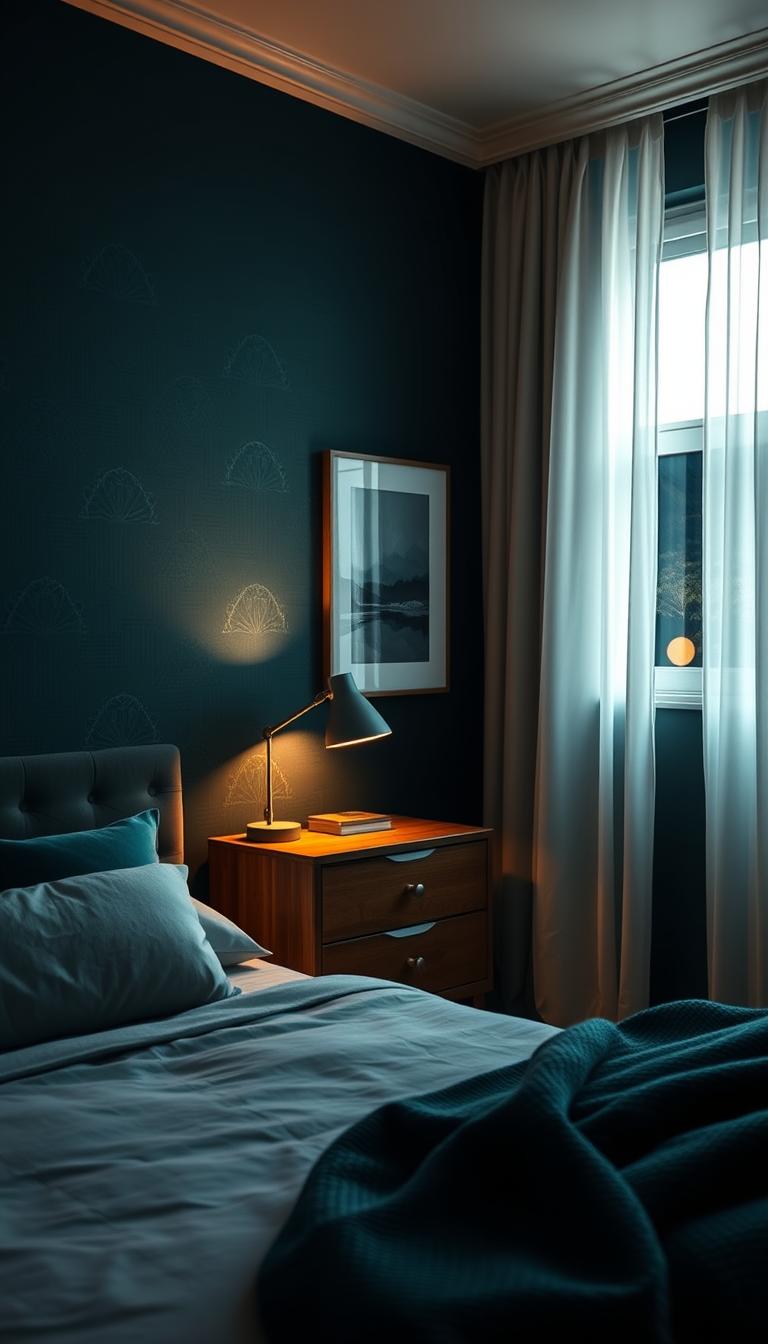
Deep hues for a cocooning, sophisticated feel
When a small space lacks sun, I lean into navy, olive, or charcoal. These hues cocoon the senses and read calm. Paint trim to match for an enveloping feel or go one shade lighter to add soft definition.
Large-scale patterns to expand perceived space
Pattern-drenching—one large-scale print across walls and even the ceiling—reduces visual breaks. The room reads bigger because the eye does not stop. If patterns feel bold, try a textured grasscloth wallpaper to add depth without busy movement.
Tonal bedding and lighting to balance bold walls
Pair saturated walls with tonal bedding and softly diffused lighting so the palette layers instead of shouting. A low bed frame or a bare canopy keeps the scheme from feeling heavy. Pull colors from an existing rug or art to root the design in your home.
| Approach | Best for | Key effect | Tip |
|---|---|---|---|
| Deep paint | Rooms with low natural light | Cocooning, sophisticated | Sample at different heights and times |
| Large-scale pattern | Make walls read continuous | Expands perceived envelope | Match ceiling for bigger space feel |
| Textured wallpaper | Pattern-shy homeowners | Depth without movement | Choose grasscloth or grasslike papers |
| Tonal textiles + soft lighting | Bold walls | Balances color; soothes eye | Use diffusers and warm bulbs |
Ceiling and Trim Tricks to Elevate a Small Bedroom
Look up—what you do overhead can read as extra height and quiet the whole plan. A focused treatment overhead changes how your space feels without moving a single piece of furniture.
Painted lids and contrast that lift
I often use a slightly darker ceiling against lighter walls. The contrast tricks the eye into seeing more height. One quick coat of the right paint makes a big impact.
Wallpaper, molding, and the vertical pull
Swathing the overhead with a subtle wallpaper or adding picture-frame molding stacked higher than usual draws attention up. Run window treatments to the ceiling line to reinforce that upward movement.
- Use the ceiling as a fifth wall—a shade overhead pulls the gaze up.
- Match the crown to the ceiling color to avoid visual breaks.
- Choose satin or matte finishes in very low rooms to keep glare down.
I favor a long, linear fixture that runs lengthwise to visually stretch the space. Keep wall art lower when the overhead is emphasized so the vertical composition creates a calm sense of lift and balanced design in your bedroom.
Headboards That Work Hard: Extended, Custom, and Statement Pieces
Think of the headboard as a horizontal wall that can carry storage, lighting, and rhythm.
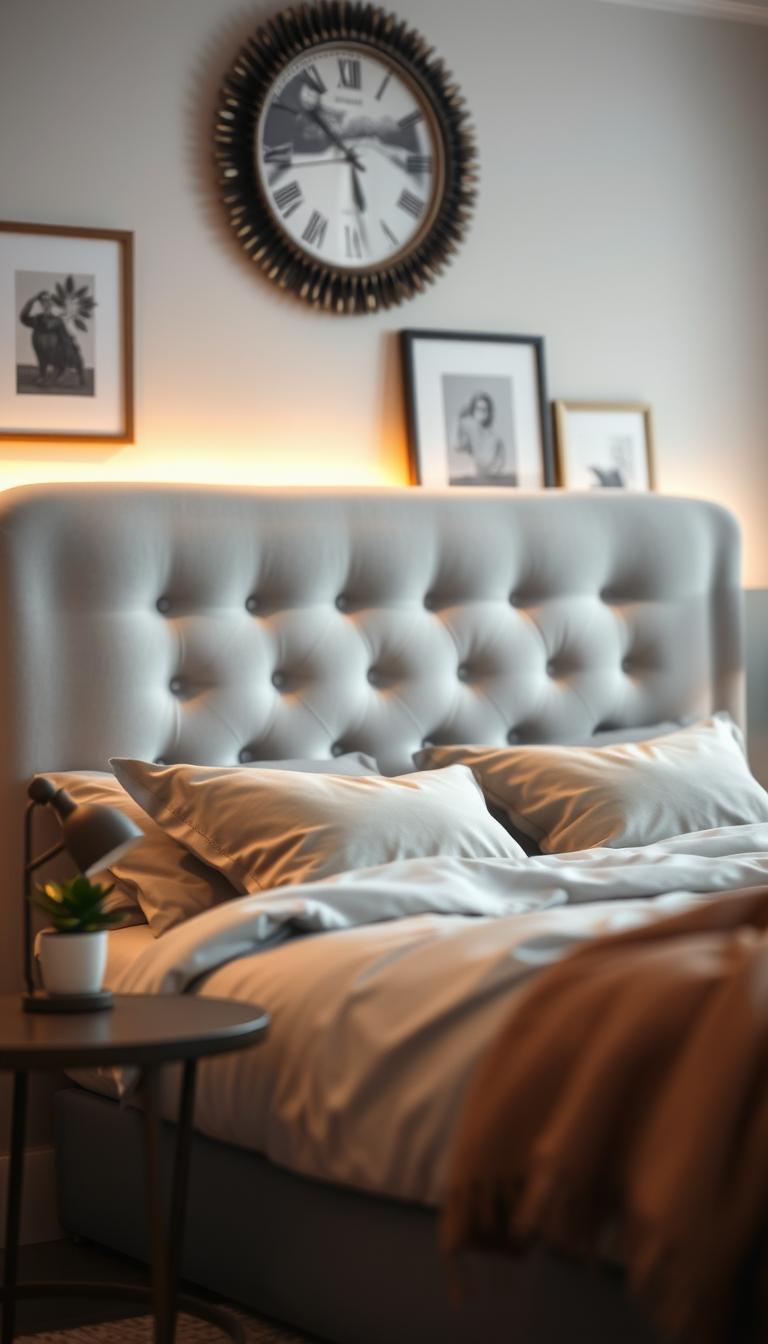
I often specify a wall-to-wall headboard panel. It widens the visual field and makes a compact bedroom feel generous.
Widen the field with one continuous plane
Extend the panel across the wall to read as a single built-in. The result feels intentional and calm.
Integrate night surfaces and hidden drawers
Custom headboards can fold in night tables and shallow drawers so you skip extra bedside furniture.
- I like upholstered panels for softness and sound absorption.
- Flank the bed with shallow shelves in alcoves for vertical storage.
- Mount sconce backplates to the headboard for perfect light placement and no wall damage.
“A slim wood frame around an upholstered panel makes the whole composition read like one thoughtful piece of furniture.”
Keep finishes tied to the bed frame so the composition reads as a single design move. It saves floor area and clears the table and night surface for things you actually use.
Make Awkward Alcoves and Tight Nooks Your Advantage
That awkward alcove? I often see it as the most charming opportunity in a room. In my work, these recesses turn into cozy, useful corners that stretch square footage without an addition.
I specify built-in beds for attic alcoves and pitched roofs. Twin beds fit neatly under eaves and feel nest-like when framed with a low-profile mattress. Stair-drawers on bunks add storage without stealing floor space.
Closet conversions are another favorite. Remove some hanging hardware, add a counter-height desk and cabinets, then tuck in open shelves for supplies. Wallpaper or a bold paint inside the nook makes the work area read as intentional, not an afterthought.
- Run a continuous ledge as a bedside shelf to avoid extra tables.
- Place reading niches in side walls so essentials stay close and surfaces stay clear.
- Align built-ins with pathways—good flow makes the whole home feel larger.
“Treat the odd corner like a built-in feature—often it becomes the room’s best part.”
When you plan alcoves this way, the bedroom works harder and the perceived space grows. Small interventions can feel like a boost to your square footage and your day-to-day calm.
Mirrors, Walls, and Surfaces: Small Moves, Big Space Feel
A full-length mirror on the back of a door is a simple change that does a lot. I’ve used this trick with clients to free wall area and keep floor space clear while adding a finished, built-in look.
Mount a full-length mirror on the back of a door
A full-length mirror mounted on the back of a door is a great way to reclaim walls for art or shelves and keep the layout uncluttered.
Fixed mounting reads custom and stops the sway and rattle you get with over-door hooks. It preserves the wall so you can hang a favorite print or add a slim shelf.
Place the mirror opposite a window to bounce light and amplify the room’s brightness. That tiny move improves the space feel without new fixtures.
- Choose thin frames or go frameless for a modern, minimal statement.
- In rentals, use high-strength adhesive strips and check the door’s weight capacity first.
- Keep adjacent walls calm—too many reflective surfaces can feel busy.
- Add a shallow ledge nearby for a brush or watch so morning routines flow.
“One well-placed mirror can make a bedroom feel wider and a morning routine much easier.”
Textiles and Bedding: Layer Light, Add Texture, Skip the Bulk
Light, honest bedding is one of the quickest ways to make a bedroom feel calm and uncluttered. I prefer coverlets or quilts over heavy duvets so the bed reads crisp and the room keeps its sense of air.
I often switch clients to a thin coverlet or quilt. The result: less visual weight and a neater silhouette. Texture still matters—matelassé, linen, or hand-stitched quilts add interest without bulk.
How I layer without overdoing it
Limit throw pillows to a purposeful trio. Extra shams feel like clutter in a compact bedroom.
- Match tones to walls for a soothing gradient, or add one accent for contrast.
- Choose breathable natural fibers for better sleep and temperature control.
- A slim bed skirt hides storage bins without adding volume to the silhouette.
- Keep one folded throw at the foot for seasonal warmth and a finished look.
“Less is deliberate. A few well-chosen pieces make the bed feel styled and the space feel larger.”
| Layer | Why it works | Quick tip |
|---|---|---|
| Coverlet / Quilt | Reduces visual bulk; keeps lines crisp | Choose washable linen or cotton |
| Textured throw | Adds depth without weight | One folded at foot is enough |
| Throw pillows (≤3) | Provides style without clutter | Use purposeful sizes and fabrics |
| Slim bed skirt | Conceals storage; keeps silhouette low | Pick minimal drop and neutral tone |
Want a deeper dive on layering? See my art of layering bedding for step-by-step ideas.
Style With Intention: Personal Pieces Without the Clutter
A few chosen objects can tell a room’s story; too many tell no story at all. I favor quiet curation—selecting accents that feel meaningful and leave breathing room. This is less about trend and more about rest.
Curate miniature art and meaningful accents
I love miniature art hung in a tight grid or a single column. One strong piece on a wall reads better than a scattered collection of forgettable trinkets.
Keep surfaces clear. Use a tray for daily essentials so night tables and dressers stay tidy. Choose furniture with hidden drawers so things have a home and you can close the lid.
What to leave out: TVs, excess pillows, and random fillers
If sleep is the priority, skip the TV. Your nervous system and your mattress will thank you. Be ruthless with pillows—limit to what you actually arrange each morning.
- Edit like a gallery curator—one meaningful object beats five fillers.
- Corral small items inside drawers or on a tray to reduce visual noise.
- Bring in a tiny plant or a sprig in a bud vase for softness and a calm note of nature.
Rotate objects seasonally so the room feels fresh without accumulating more stuff. These small moves help you make small bedroom moments feel intentional and turn bedrooms in your home into places that calm and comfort.
Conclusion
Start with one measured change and you’ll watch the whole room fall into place. Honor the layout, scale your beds and furniture wisely, and layer lighting beyond a single overhead to make the space feel calm and generous.
Use the walls—built-ins, high shelves, and sconces—to reclaim square footage and create useful storage. Lean into confident color or pattern, then balance it with tonal bedding and warm glow so the room reads restful, not crowded.
I promise: simple swaps like Roman shades, a back-of-door mirror, and a lighter coverlet change daily life more than a big overhaul. These bedroom ideas are practical, immediate, and kind to your home.
Start this weekend: mount a sconce, clear a surface, or shift the bed two inches—and feel the space expand around you.