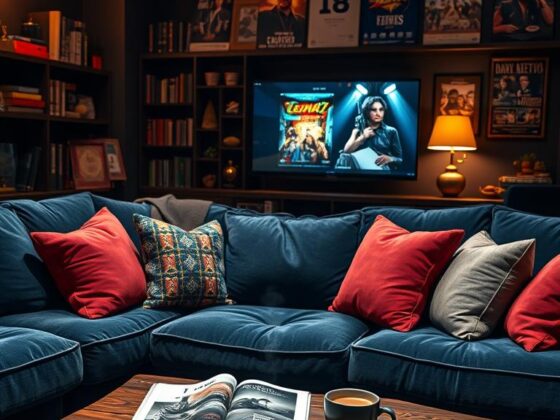

Ever wondered if a dark palette can actually make your morning routine feel calmer and more deliberate?
I ask because I’ve seen a simple shift to deep tones transform a small space into a cozy retreat. Painting a room dark absorbs light, softens edges, and creates a cocoon that helps you slow down.
I’ll walk you through the choices that matter most—finishes, lighting layers, and the right materials—so your space looks striking and functions beautifully every day. Expect practical tips on picking matte or gloss, mirrors that amplify light, and vanities that anchor the look.
My goal is to balance drama with ease of upkeep. From porcelain and marble to LVT, you’ll learn which materials deliver texture and performance without extra worry.
Key Takeaways
- Dark palettes can promote calm by softening hard lines and reducing visual clutter.
- Contrast—white fixtures or brass—gives a timeless, refreshed look.
- Choose finishes and lighting that boost mood and daily function.
- Materials like porcelain, marble, and LVT balance beauty with durability.
- I’ll show scale-friendly ideas for small powder rooms and larger spa baths.
Modern reasons to choose a black bathroom today
Going dark isn’t about trendiness; it’s about making a space that soothes and focuses the senses.
I recommend a darker scheme because it quiets visual noise and makes routine feel deliberate. I’ve seen clients call it a nightly sky that turns grooming into a small ritual.
Contrast is a big advantage. Dark surfaces make skin tones and white fixtures pop, so grooming feels easier and the overall look seems more refined.
- Finishes matter: matte hides fingerprints; a soft sheen bounces light—mix them for depth.
- Dark hues frame tile edges and stone veining, letting metals and wood bring warmth.
- If you’re cautious, start with a vanity or a single tile wall to test the choice.
| Benefit | Why it works | Quick test |
|---|---|---|
| Mood & calm | Reduces visual clutter and emphasizes ritual | Paint one wall |
| Clear contrast | Improves grooming and refines the look | Pair white fixtures |
| Timelessness | Black white schemes refresh with accessories | Swap towels or metals |
Go all‑black for a moody, spa‑like retreat
An all‑black envelope can feel like a private spa—calm, curated, and quietly luxurious. I love how fully embracing dark walls, tiles, and fixtures mutes visual clutter and makes the space read as serene right away.
Matte vs gloss finishes on walls, tiles, and fixtures
Matte on large walls and big-format tiles cuts glare and hides fingerprints. It keeps surfaces soft and velvety under warm light.
Gloss works wonders on accents—mosaic trim or a single glossy niche adds a little sparkle without shouting.
Balancing light levels so dark spaces still feel relaxing
Layer your lighting: warm ambient ceiling light, task sconces or a backlit mirror, and low-level night lighting for safety. Backlit mirrors deliver even, shadow‑free light that’s ideal for grooming.
- Use bulbs with CRI 90+ and 2700–3000K for true, cozy skin tones.
- Add texture—ribbed tile, fluted stone, or honed porcelain—to stop deep surfaces from feeling flat.
- Keep grout close to the tile tone for seamless surfaces; clear frameless glass keeps the room feeling open.
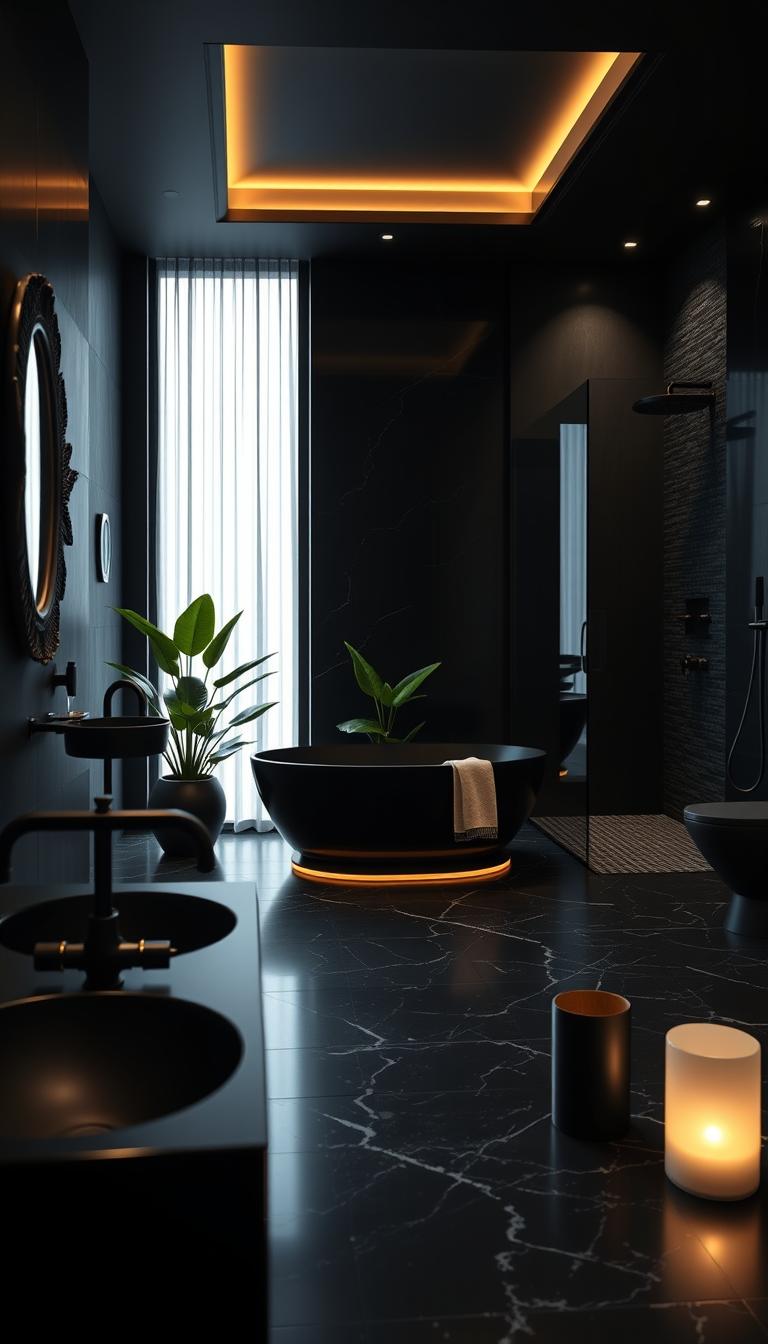
Timeless black and white bathroom ideas with high contrast
A crisp black white scheme reads like a gallery wall — clean, focused, and endlessly updated.
I often pair inky wall tiles with a white sink or freestanding tub. The sharp meeting line becomes the room’s focal point.
Refresh without remodeling: swap towels, add a warm oak stool, or introduce brass tapware to change mood fast.
White fixtures against dark tile as a crisp focal point
Place a white sink or tub against deep tile to make that edge sing. Black trim or thin metal reveals sharpen silhouettes and feel intentional.
Playing with proportion: walls, floor tiles, and mood
Flip the script with white floor tiles and dark walls for a grounded, gallery-like look.
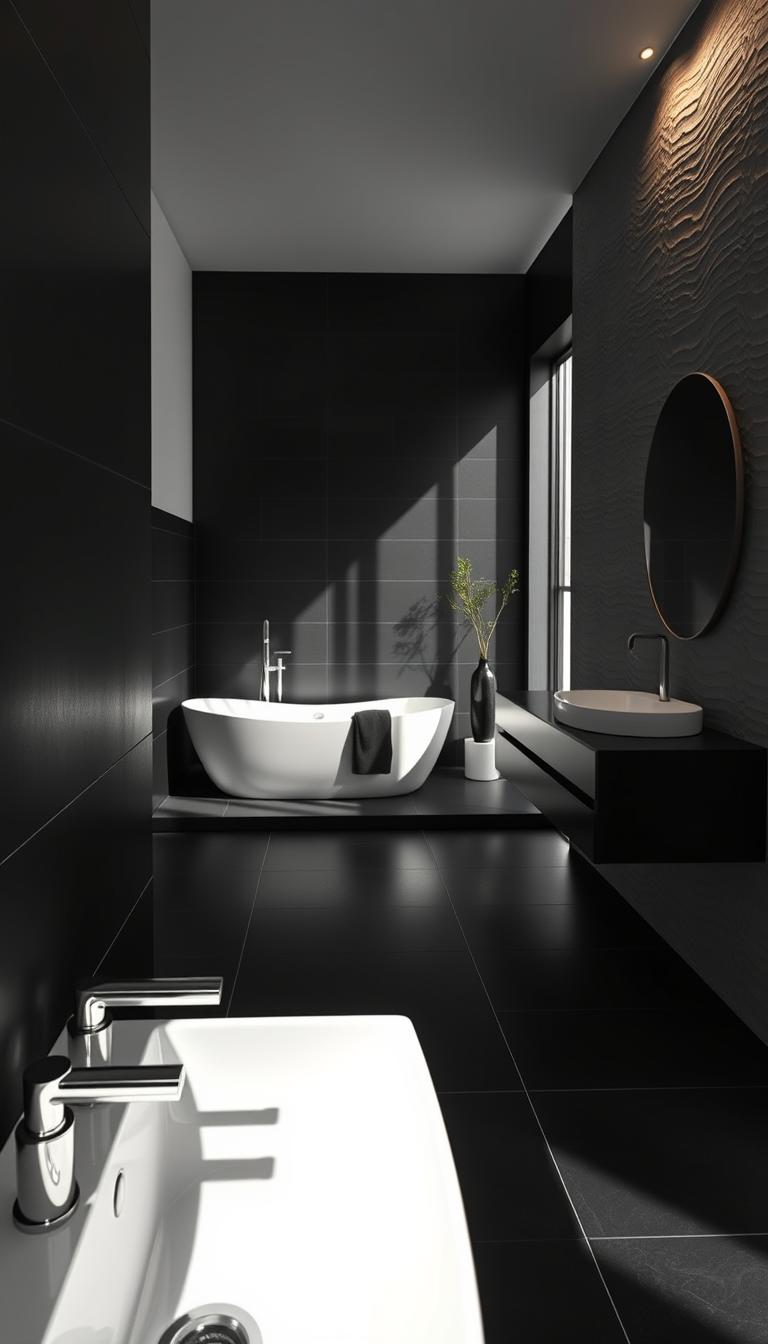
- Graphic monochrome tile—herringbone, hex, or basketweave—adds movement.
- Keep grout tidy; warm white grout reads softer under bright light.
| Idea | Effect | Quick tip |
|---|---|---|
| Inky wall tile + white tub | Strong focal point | Use thin metal reveal |
| White floor tiles + dark walls | Gallery-like, modern | Keep ceiling white |
| Monochrome graphic tile | Movement without color | Stick to two tones |
This set of ideas will keep your bathroom looking timeless while letting small accessories steer the style.
Black Bathroom Design: top list ideas to try now
Start with one confident element and let it guide the rest of the scheme. I like beginning with a focal piece because it makes decisions easier and faster.
Statement vanity and mirror combos
- Go bold with a floating black vanity topped in white quartz or marble veining and pair it with an oversized black-framed mirror.
- Anchor the room with a round mirror to soften lines, an arched mirror for lift, or a pill-shaped option for modern flair.
Graphic tile patterns and texture-rich surfaces
- Try herringbone backsplashes, hex floors, or basketweave marble for movement that feels both modern and timeless.
- Mix honed porcelain, ribbed wall tile, and matte paint to keep surfaces tactile and interesting.
Warm metallic accents for depth and contrast
- Layer brass knobs, gold-toned sconces, or a satin-brass faucet to warm the palette and add contrast.
- Add a ledge shelf under the mirror with hidden LED strips for soft task light and everyday essentials.
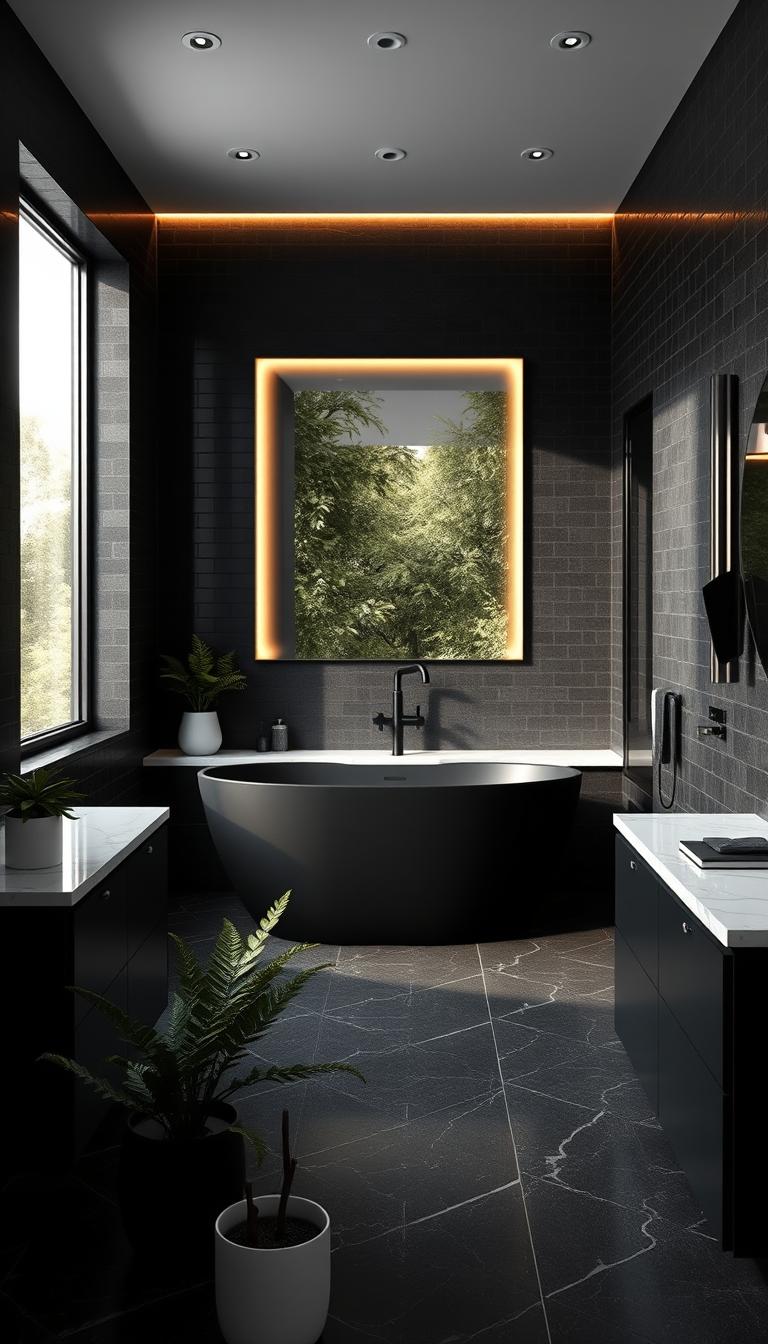
Keep styling minimal—one leafy stem, a stone tray, and a woven towel finish the look without clutter.
Black bathroom vanities that anchor the space
A vanity is more than storage—it’s the visual anchor that sets the room’s tone. I choose a strong unit to ground the composition and guide the rest of the materials and surfaces.
Small vanities for powder rooms vs expansive double units
- I love a 24–30 inch vanity in a tight powder room; drawers beat doors for real storage in compact footprints.
- Double vanities bring hotel-level ease to a primary bathroom and split routines without crowding the space.
Floating vanities to open up floor surface and sightlines
Floating vanities visually expand floor area and make cleaning simple. Add under-vanity LEDs for a soft night glow and a luxe feel.
Countertop choices: white quartz, marble veining, or black solid surface
- White quartz brightens the look and highlights a sink as the focal point.
- Marble-look tops add luxe movement without high maintenance.
- Black solid surfaces read seamless and modern when you want a monolithic feel.
Match your sink to the vibe—integrated tops for minimalists, vessel bowls for sculptural drama, trough sinks for shared routines.
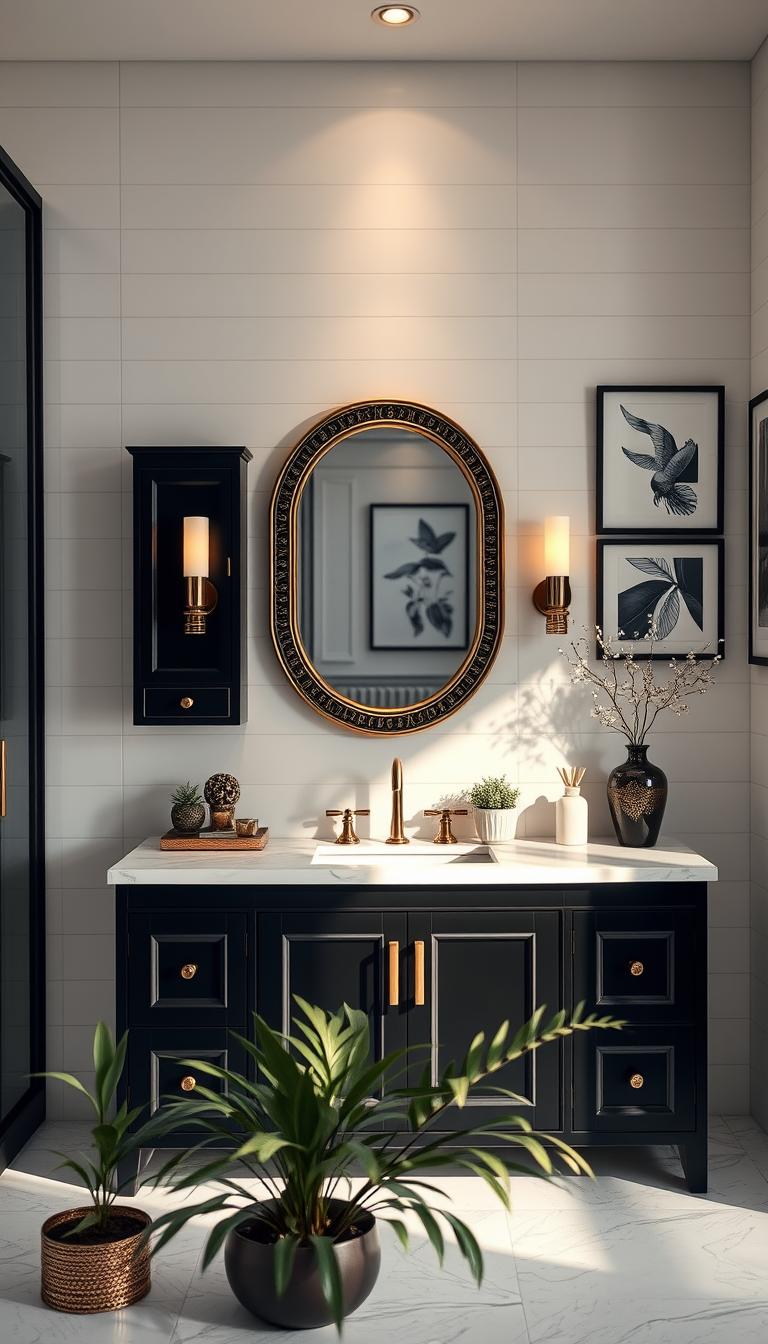
- PVD matte black or brushed brass handles resist wear and warm the style.
- Echo the vanity finish on mirror frames or niche trim for cohesive flow.
- Add a tall side cabinet or mirrored tower for vertical storage without crowding the footprint.
Mirrors that multiply light in a dark palette
A thoughtfully chosen mirror does more than reflect — it stretches the perceived space. I rely on oversized or full-height mirrors to bounce light around deep walls and visually double the room.
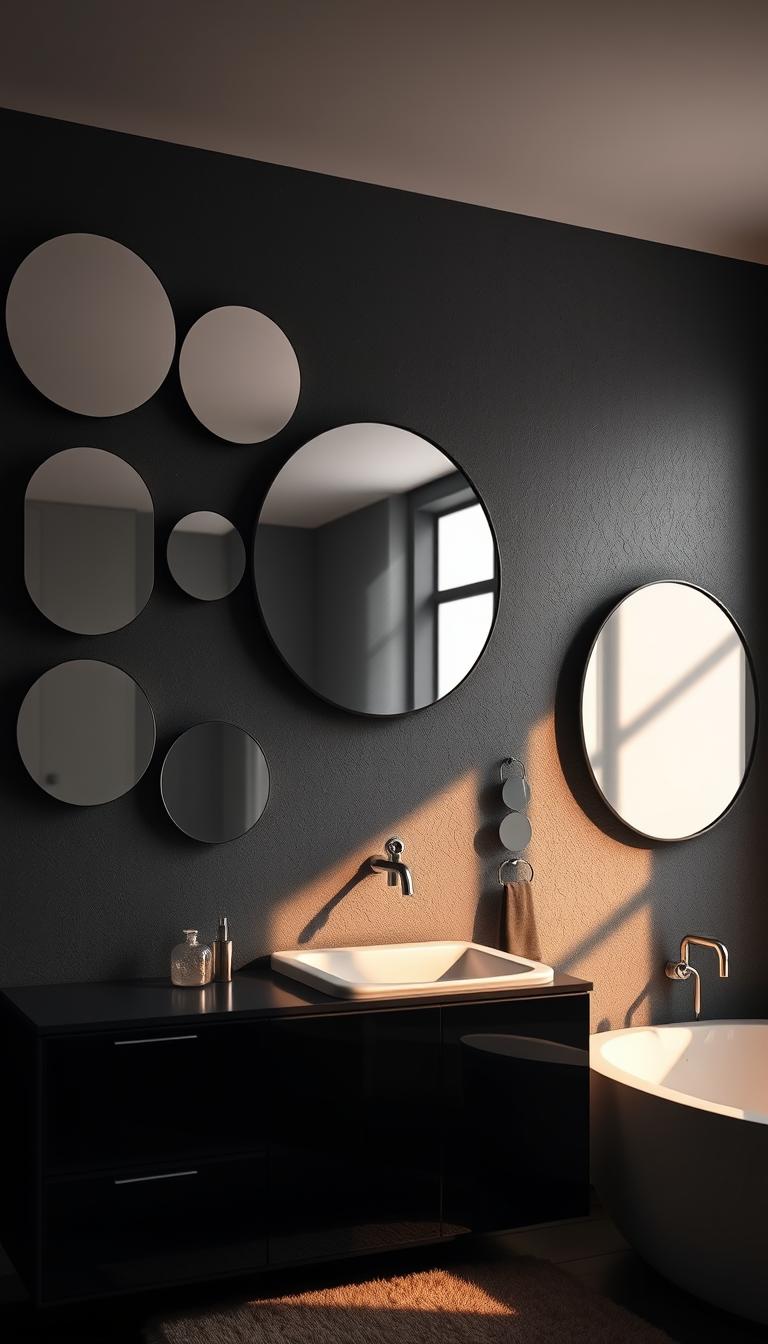
Backlit mirrors give even, shadow-free lighting that flatters skin tone and makes grooming simple. They add a soft halo that changes the whole look without extra fixtures.
I often specify twin mirrors for double vanities or one wide mirror to unify lines and clean up visual clutter. Black-framed mirrors read like artwork and give crisp definition against dark surfaces.
Angle a mirror to catch a window when you can; a small shift will brighten the space dramatically. Pair mirrors with side sconces at eye level to reduce shadows and boost clarity.
- Mirrored cabinets hide storage while keeping brightness.
- Arched or round mirrors soften rectilinear tile and add calm rhythm.
- Use an oversized mirror to make a narrow bathroom feel wider and more open.
Brass and gold accents to add warmth to black surfaces
A dash of gold changes the mood instantly, shifting a cool scheme toward cozy without heavy lifting. I use warm metals to humanize deep tones and to give every touch point a little ceremony.
Brass faucets, sconces, and hardware add immediate warmth and sophistication. They pair beautifully with a dark vanity and a marble backsplash, highlighting veining and texture.
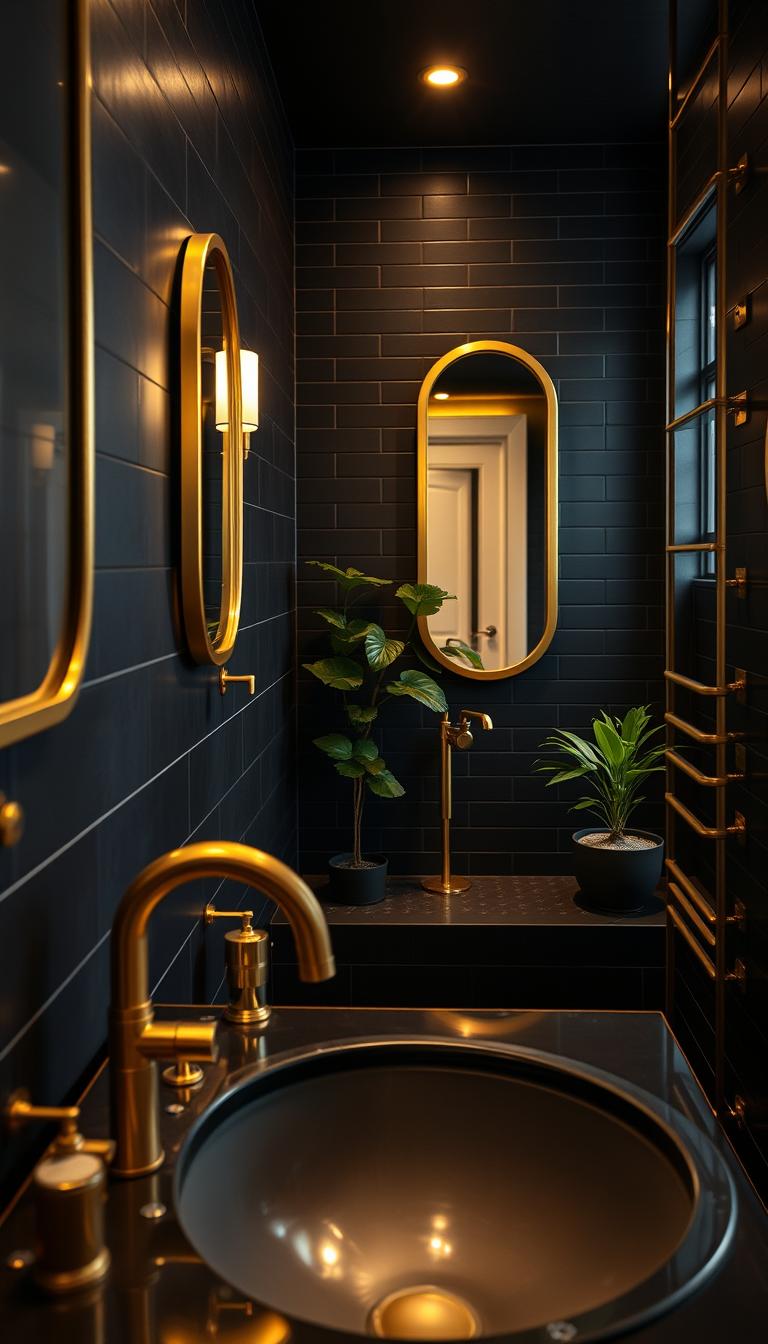
- Choose a single family of finishes — brushed, satin, or unlacquered — for harmony across taps, pulls, and lighting.
- Keep metal choices focused: one or two finishes avoid visual clutter and strengthen the overall look.
- If you like patina, try unlacquered brass; if you prefer low care, pick PVD-coated tones.
- Use small accents — soap pumps, towel hooks, a brass shelf rail — to tie the style together.
| Element | Effect | Quick tip |
|---|---|---|
| Brass faucet | Instant warmth | Match to vanity pulls |
| Gold sconce | Highlights stone | Place at mirror height |
| Brass rail | Tailored, boutique feel | Use on a ledge |
“Warm metals are the shortcut to balancing cool surfaces with instant intimacy.”
Keep the metal count low and let brass or gold be the accent that creates warmth. A cohesive approach lifts the whole bathroom and keeps the final design feeling intentional.
Marble, porcelain, and LVT: material choices that elevate
Materials decide how a room looks, and how it lives. I pick finishes by balancing daily use with the mood I want. Good surface choices give style without extra fuss.
Low‑maintenance porcelain vs natural stone needs
Porcelain that mimics stone without the chores
Porcelain offers rich marble looks with far less upkeep. It resists stains, needs no sealing, and works well for both walls and flooring.
Natural marble brings unmatched character, but it asks for sealing and gentle cleaners. In busy homes, I often recommend honed marble or a porcelain marble‑look to get the vibe without the care load.
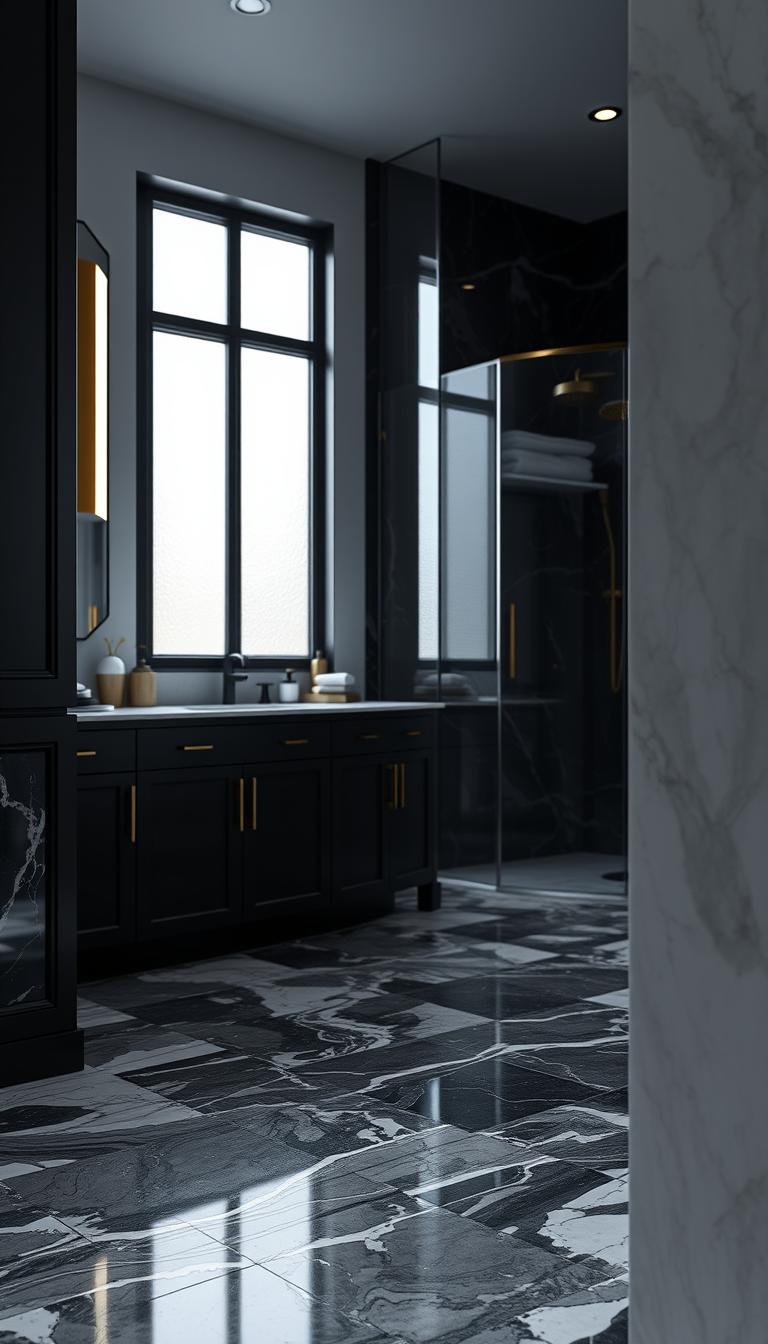
Slip resistance, grout, and longevity for wet zones
For showers and wet floors, prioritize slip resistance. Textured porcelain or small mosaics give better traction than large polished slabs.
- Performance first: I weigh materials by durability—porcelain for low care; marble for beauty with maintenance.
- LVT benefits: Warm underfoot, budget friendly, and forgiving—great for comfort and easy upkeep.
- Grout matters: Match grout to tile for a seamless surface or go slightly lighter to show pattern—seal grout to reduce staining.
- Scale and sheen: Large floor tiles cut grout lines; mosaics in showers improve grip. Choose matte or satin so floors don’t glare.
- Edge details: Schluter trims or mitered edges finish black tile surfaces cleanly and protect vulnerable corners.
Pick materials that fit how you live. That way the room looks elevated and stays sensible for years.
Tiles, walls, and floors: patterns that make the room
Pattern can set a room’s rhythm—use it to guide sightlines and slow the eye.
I use tiles to create tempo. Herringbone backsplashes add movement. Hex floors give geometry and modern rhythm. Basketweave marble feels timeless and gentle.
Extend the same floor into the shower to create visual continuity and make the space feel larger. Just plan slope and pick slip‑resistant material for safety.
On walls, balance bold pattern with stretches of solid tile or paint so the room stays calm. Keep grout joint sizes consistent to hold the eye and steady the look.
Mix texture—a ribbed wall tile next to a smooth floor creates depth without adding color. For a scheme that leans dark, a faintly veined porcelain floor lightens the composition.
Low ceiling? Run vertical stack‑bond tile to make the space feel taller. Or try a tile wainscot with painted upper walls for a tailored, budget‑friendly finish.
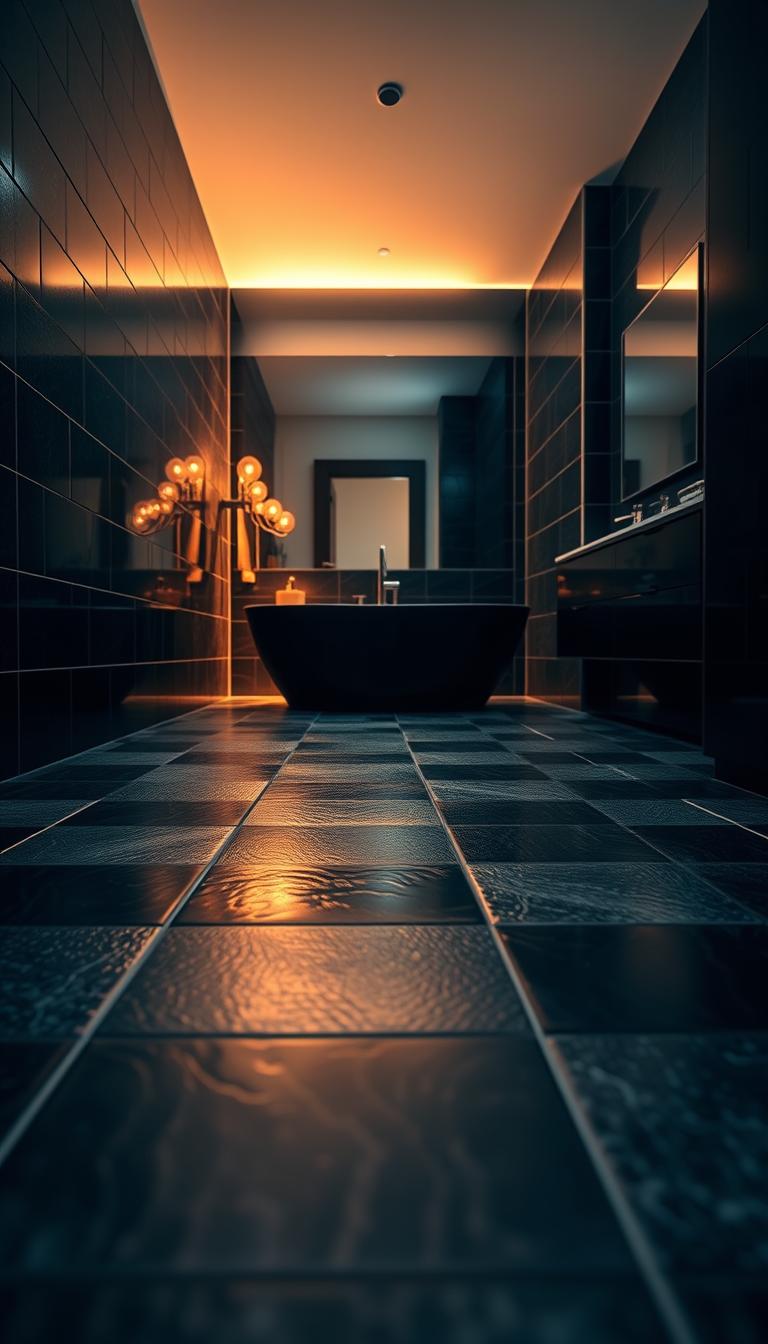
| Pattern | Effect | Quick tip |
|---|---|---|
| Herringbone backsplash | Visual movement behind fixtures | Use smaller tiles for tight spaces |
| Hex floor | Geometric anchor, modern feel | Match grout to tile tone |
| Basketweave marble | Timeless texture and warmth | Seal grout and stone as recommended |
| Same floor into shower | Seamless, larger look | Ensure slope & choose slip resistance |
Final thought: let pattern lead, but keep other surfaces calm. The right tiles and walls will lift the bathroom look and make daily routines feel considered.
Lighting layers that flatter black bathrooms
Good lighting makes dark finishes feel intentional, not oppressive. I map three layers—ambient, task, and accent—so the room reads clearly from morning routines to late-night mirror checks.
Task, ambient, and accent working together
Start with ambient overhead for a gentle, even glow. Add task at face level for grooming. Then layer accent to model the texture and create depth.
- Warm-white bulbs (2700–3000K) with high CRI show true skin tones.
- Use dimmers to move from bright mornings to calm evenings.
Black vanity lighting with brass details for a cohesive look
I like a dark vanity light paired with brass hardware. The contrast adds warmth and ties fixtures to taps and pulls.
Keep the lines of fixtures clean—linear bars or twin sconces at eye level give even illumination and tidy sightlines.
Backlit mirrors and LED strips for shadow-free grooming
Backlit mirror cabinets and under-vanity LED strips remove harsh shadows and make late-night trips gentle on the eyes.
Choose IP-rated fixtures in wet zones and wet-rated recessed lights for showers to ensure safety and longevity.

| Layer | Purpose | Quick tip |
|---|---|---|
| Ambient | General, even glow | Ceiling fixture + dimmer |
| Task | Face-level grooming light | Twin sconces or bars at eye level |
| Accent | Depth, texture, mood | LED strips under vanities or niches |
| Shower lighting | Safety and visibility | Wet-rated recessed fixtures, avoid glare |
“Layered lighting makes a moody palette practical — and surprisingly forgiving.”
Showers and tubs: glass, wet room vibes, and focal points
A glass enclosure can make the wet zone feel like an uninterrupted part of the room, not a boxed-in chore. I favor solutions that keep sightlines open so the space reads larger and calmer.
Frameless glass to preserve visual flow
Frameless clear glass keeps sightlines open and showcases your tiles and wall finishes. It’s easier to clean and looks modern without heavy framing.
Walk‑in showers, alcoves, and freestanding tub moments
Walk‑in showers with linear drains read clean and deliver a spa-like feel. Alcoves still win in compact layouts — they’re efficient and tidy.
A freestanding tub placed against a black tile wall becomes an instant focal point. Just confirm floor support and clearance before you commit.
- Run the same floor tile into the shower to unify the room; use mosaics on the pan for slip resistance.
- Place recessed niches on the long wall for cleaner lines and less soap scum build-up.
- Pair a ceiling-mounted rain head with a handshower for flexible, spa-like function.
- For steam or high humidity, invest in robust ventilation and full waterproofing behind walls and ceilings.
- Use minimal hardware in black or brass to keep the composition calm and considered.
“Treat the tub or shower as a design stage — choose materials and details that let it be the room’s quiet hero.”
Storage solutions that keep black bathrooms clutter‑free
When storage works, the space reads cleaner and mornings move faster.
I prefer built-ins that preserve clean lines and clear surfaces. Recessed niches and tall cabinets keep essentials off counters. Mirrored doors hide clutter and bounce light so the room feels brighter.
Recessed niches, mirrored cabinets, and tall wall units
Recessed niches in showers and above the vanity save room and keep wet items tidy. They preserve sightlines on the walls and make cleaning easier.
Mirrored cabinets double as storage and a light amplifier—ideal in a compact space. Drawer-based vanities give better organization than single doors; add a shallow top drawer for daily items.
- Tall wall units use vertical space for linens without crowding the floor.
- Use matte black organizers or clear bins inside drawers for quick visual order.
- Add a slim open shelf for a styled object; store bulk behind doors.
- Integrate outlets inside cabinets for toothbrushes and trimmers—counters stay clean and cords stay hidden.
| Solution | Effect | Quick tip |
|---|---|---|
| Recessed niche | Clears shower ledges | Tile back for easy clean |
| Mirrored cabinet | Concealed storage + light | Choose soft-close hinges |
| Drawer vanity | Organized daily zones | Use shallow top drawer |
| Tall wall unit | Vertical linen storage | Anchor to studs for safety |
“Good storage is the silent hero of any calm routine.”
Small space black bathroom strategies
When floor space is precious, thoughtful fittings create breathing room.
I lean toward fixtures that free floor area. Wall-hung toilets and floating vanities reveal more visible floor and make cleaning easier. They also let the eye travel under the vanity, so the room feels wider.
Wall‑hung toilets, pocket doors, and large mirrors
Pocket or sliding doors reclaim inches that swing doors steal. That one change often lets you add a larger vanity or extra storage.
Big mirrors double perceived depth and bounce scarce light. Pair a wide mirror with low-contrast finishes so reflections read continuous rather than chopped up.
Where to place dark paint or tile to avoid a cramped feel
Concentrate dark tile on one focal wall or the lower half of the room. Keep the ceiling and adjacent walls lighter to avoid a boxed-in look.
Run the same floor into the shower and choose clear glass enclosures to preserve visual flow. A continuous floor plane makes the space read as one, longer surface.
- I love wall-hung toilets and floating vanities to reveal more floor—instantly the space feels larger and easier to clean.
- Pocket or sliding doors reclaim valuable square footage that swing doors steal.
- Use large mirrors to visually double depth and bounce scarce light; pair with consistent, low-contrast finishes.
- Concentrate dark tile on one focal wall or lower half of the room; keep ceilings and adjacent walls lighter.
- Run the same floor into the shower and choose clear glass to preserve visual flow.
- Keep patterns restrained—one graphic moment is plenty in compact layouts.
- Add slim sconces or a backlit mirror to avoid bulky fixtures that protrude into tight zones.
- Streamline accessories and opt for built-in storage to keep the look calm and uncluttered.
| Strategy | Benefit | Quick tip |
|---|---|---|
| Wall-hung fixtures | More visible floor, easier clean | Confirm wall carrier ratings |
| Pocket/Sliding door | Reclaims swing space | Allow for jamb and trim details |
| Continuous floor | Unifies room and shower | Use same tile and grout tone |
| Large mirror + low-contrast finishes | Doubles depth and reflects light | Mount at eye level, add backlight |
Want more compact ideas? Check these small black bathroom ideas for layouts and fittings that make tight spaces sing.
Finishes and hardware: choosing the right black
The sheen you pick can change how a room breathes and how it wears over time. I pay attention to finishes early because they shape daily care and the long-term look.
Matte, satin, or gloss? Matte hides fingerprints and water spots, satin gives a soft glow, and high-gloss adds drama but shows marks faster.
Durability and care
Matte tapware and hardware: durability and care
I often specify PVD-coated fixtures for wet zones. They resist scratches and corrosion much better than plain finishes.
- I weigh finish by lifestyle: matte hides fingerprints; satin offers a soft sheen; high-gloss delivers drama but shows marks.
- Choose PVD-coated fixtures for superior scratch and corrosion resistance.
- Clean matte gently—mild soap and a microfiber cloth; avoid harsh chemicals that can cloud the surface.
- Coordinate sheens across tapware, pulls, and lighting for a cohesive look, or intentionally contrast for depth.
- Test samples in your bathroom light; finishes shift under warm vs cool bulbs.
- Black overflow caps, drains, and hinge details complete the look without chrome “noise.”
- If mixing metals, let dark finishes be the base and one warm metal be the accent.
- Match accessory profiles—linear, rounded, or knurled—to echo your tile and cabinet lines.
| Finish | Best for | Quick tip |
|---|---|---|
| Matte | Low-maintenance homes | Use mild soap; microfiber cloth |
| Satin | Balanced sheen & longevity | Coordinate with lighting warmth |
| Gloss | Statement fixtures | Expect more fingerprints; frequent wipe-downs |
“Pick finishes that match how you live—then enjoy the room, not just admire it.”
Budget, durability, and value considerations
Start your budget plan by protecting what’s invisible—waterproofing and solid plumbing save more than a pretty tile ever will.
I always invest first in the invisible heroes: robust waterproofing, quality plumbing valves, and safe, layered lighting. Those items stop expensive failures and protect long-term value.
To stretch a budget, consider refinishing rather than replacing. New grout and sealers can revive sound tile. Painting or spraying an existing vanity front and changing hardware gives a fresh look for far less than a new unit.
- Keep the layout: moving plumbing raises labor and materials costs—often the largest part of a job.
- Choose durability: pick porcelain in high‑use zones over delicate stone to cut care and future expense.
- Quick wins: swap a countertop and new pulls on current vanities for a big visual lift.
- Plan finances: get at least three detailed quotes and build a 10–20% contingency. Labor can be 40–60% of total cost.
“Invest where it matters—behind the wall and in good fixtures, then let finishes deliver the style.”
Sustainable, water‑smart, and tech‑savvy ideas
Sustainable swaps—thoughtful fixtures and simple automation—deliver comfort and long‑term value. I pick small changes that save water and make everyday routines nicer.
Start with efficient plumbing: dual‑flush toilets, aerated taps, and low‑flow showerheads cut water use without losing performance. I specify these for client projects and they work—strong spray, less waste, lower bills.
LED lighting with dimmers or occupancy sensors trims energy use and lets you tune mood and task light. Smart controls can pre‑warm floors, run ventilation on a schedule, and track water use so you spot leaks early.
- Choose durable, repairable fixtures so you replace less and waste less.
- Install humidity sensors or heat‑recovery ventilation for better air quality and efficiency.
- Use recycled‑content tiles and low‑VOC paints to keep air healthy in a steamy space.
- Keep one warm material—wood or woven textiles—to bring human warmth and soften the look.
- Future‑proof wiring and add access panels for easier upgrades later.
| Upgrade | Benefit | Quick tip |
|---|---|---|
| Dual‑flush toilet | Less water per flush | Choose reliable valve brands |
| Low‑flow showerhead | Cut water, keep pressure | Try aerating or laminar models |
| Smart controls | Comfort + savings | Link floor warming and ventilation |
Bottom line: sustainable choices improve the room’s function and style while protecting resources. Little investments today mean a more efficient and lasting space tomorrow.
From plan to polish: a quick process checklist
Begin by nailing layout and ventilation—those choices steer every later decision. A clear plan prevents surprises and keeps costs down.
Layout, ventilation, and electrical safety
Placement and wet‑zone rules
Start with the layout. Confirm where the shower sits and place the exhaust fan nearby for fast moisture removal.
Mark safety zones for switches and outlets. Use GFCI circuits and keep fixtures outside wet‑zone limits unless they’re IP‑rated.
Project sequence I use on every job
- Preparation & demolition — protect adjacent space and confirm structural notes.
- Framing & rough‑ins — plumbing and electrical go in before walls close up.
- Waterproofing — membranes and correct shower slope come next, always before tiles.
- Wall and floor finishes — tile layout, grout choice, and consistent sightlines.
- Fixture installation — dry‑fit vanities, tubs, and glass to verify clearances.
- Lighting & controls — install, test dimmers, and confirm LED compatibility.
- Finishing touches — seal grout, color‑match caulk, polish mirrors, and adjust hardware.
- Final checks — test ventilation, run GFCI tests, and walk a punch list with the client.
“Waterproof once, tile once—get the membrane right and you’ll avoid future leaks.”
Dry‑fitting and testing early saves headaches later. I always commission the fan by runtime and confirm smart controls work with dimmers. Then I style lightly so the room’s look and feel stay calm and intentional.
Conclusion
Wrap your plan around one confident move—a vanity, a new light, or a single accent wall—and the rest will follow. Start small and let a single upgrade create momentum.
A balanced approach wins: contrast and texture make the look durable, brass accents add warmth, and porcelain gives low‑maintenance performance compared with natural stone. Layered lighting—especially backlit mirrors and dimmers—keeps function and mood in harmony.
Keep storage integrated so surfaces stay calm. Whether you go all‑dark or mix white for high contrast, you’re shaping a bathroom that feels like a daily retreat.
If you’re curious about a strong anchor piece, see why many choose black bathroom cabinets for lasting impact. I’m here to help you make choices that last—beautiful, durable, and sensible.