
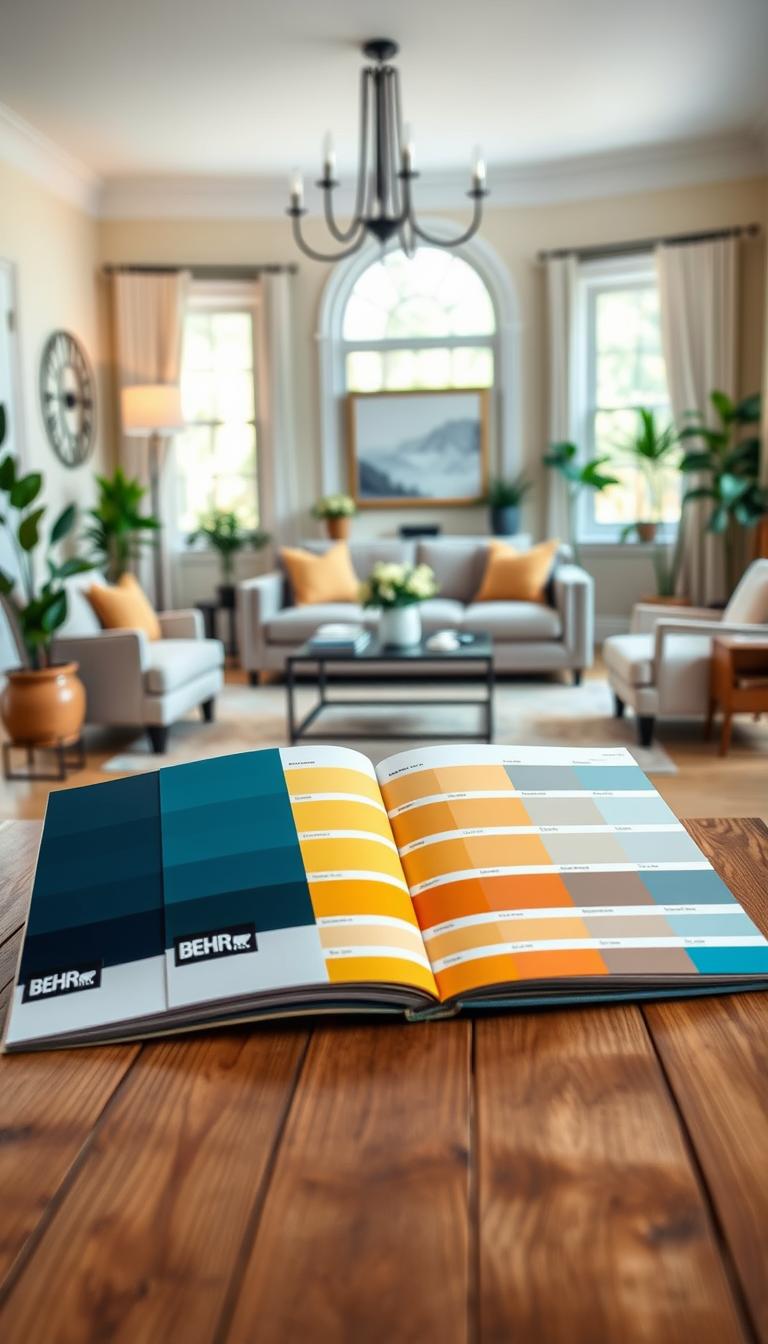
Ready to pick a shade that makes your home feel alive — not just trendy? I ask this because choosing the right paint color can change how you move through a room, how light reads on your walls, and how calm or energized you feel each day.
I’ve guided hundreds of homeowners through Behr Paint Colors, and I start with one rule: design for how you want to feel. Is it a soft, wake-up-in-morning calm for the bedroom, a cozy hug for the kitchen, or a clean, modern ease for open living?
We’ll use a simple decision tree — pick the mood, test large swatches on two walls at different times, and watch undertones reveal themselves. I’ll also show how to build a color palette that flows from room to room and how to test sheen for real life: kids, pets, and steam included.
Key Takeaways
- Start by naming the mood you want in each room.
- Test large swatches at eye level and view them at different times.
- Watch for undertones — they can change a hue’s whole personality.
- Build a flowing color palette for smooth transitions between rooms.
- Choose sheen and finish based on how the room is used.
Resource Hub Overview: Find the Perfect Color, Finish, and Product Today
I use one hub to simplify big decisions. Start by trying color tools to shrink your shortlist and to help find perfect matches for each room.
Colorsmart Behr lets you preview hues on sample rooms and upload photos of your own space. Order a sample color and a larger color sample to check both light and sheen on real surfaces.
Label each sample colorid on the wall. Take photos at morning, afternoon, and evening. Those quick steps stop second-guessing.
“Treat the hub like a smart assistant—compare side-by-side, organize samples, and plan purchases.”
Quick checklist:
- Use color tools to narrow options.
- Order a sample color and a larger color sample.
- Label each sample colorid and photograph at different times.
| Step | Why it matters | Result | Where to buy |
|---|---|---|---|
| Preview online | Catch undertones early | Fewer mismatches | Colorsmart Behr |
| Order samples | Test light and sheen | Confident pick | Sample color sample |
| Pick finish | Match use and durability | Easy upkeep | Home Depot |
When you’re set, I’ll walk you through prep, tools, and timing so your weekend stays on track and your project finishes on schedule.
Behr Paint Colors: Choosing a Palette That Matches the Mood You Want
Start with the feeling you want and let that feeling guide the hue choices. I ask clients to name the mood want in plain words—calm and restorative, gather and glow, or clean and lively. That single phrase steers the next steps.
Warm vs. Cool Families for Living Rooms, Kitchens, and Bedrooms
If the mood want is calm and restorative, I lean into cool-leaning neutrals—soft grays and misty greens. They slow the visual tempo and help people relax.
When the mood want is gather and glow, warm paint colors do the work. Sunlit creams and amber-kissed beiges make kitchens and dining rooms feel like golden hour.
Bedrooms need lower contrast. Pick a paint color with muted undertones for sleep, and use a slightly higher-sheen trim for subtle definition.
Creating a Cohesive Color Palette Across Open-Concept Spaces
For open plans I build a color palette with one anchor neutral, a sister shade two tones lighter or darker, and a single accent that pops in small doses. Use it on pillars, built-ins, or one focal wall.
My rhythm: neutral walls, deeper doors, crisp trim. It’s simple, timeless, and easy to refresh when your style changes.
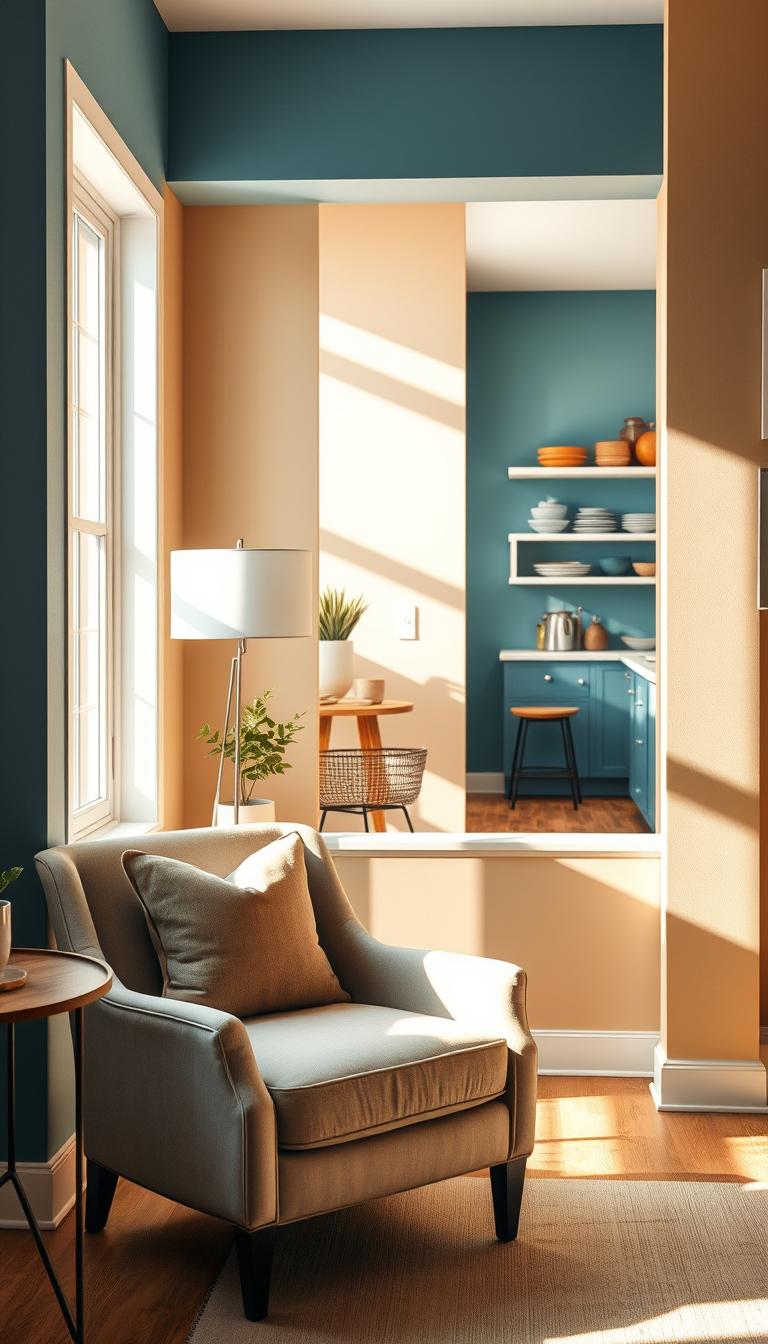
Using Color Tools to Help Find the Perfect Color
Use color tools to spot-test on virtual walls, then turn top picks into real samples. Compare them next to a clean sheet of printer paper to catch undertones that flash purple, pink, or green.
“Test on real walls and at different times of day—screen balance rarely equals real light.”
- Tip: Narrow to three favorites, then live with samples for 48 hours.
- Tip: Add art, textiles, and plants to see how accents shift the mood.
Exterior Paint Sheens Explained: Flat, Satin Enamel, Semi-Gloss, and Hi-Gloss
A finish can make a modest siding read elegant or show every flaw — so choose wisely. The right sheen affects glare, cleanability, and how textures read from the curb.
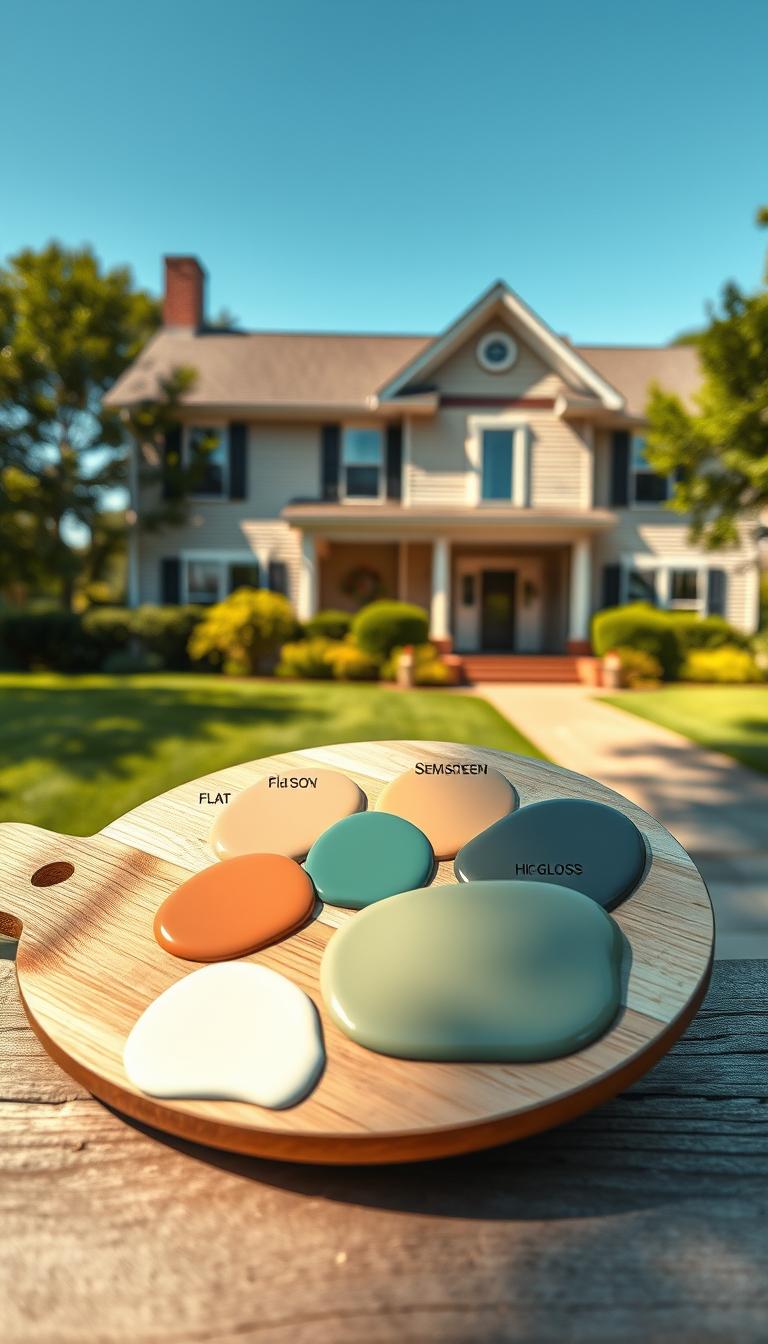
Flat: Non-reflective, easy to apply and touch up. It hides small surface imperfections and soaks in light for a subdued look. Best for wood siding, vinyl, brick, masonry, and fences. Durability: Medium-Low.
When to pick Satin Enamel
Satin Enamel gives a pearl-like finish that resists dirt, moisture, and fading. I reach for satin as a reliable all‑around choice for virtually all exterior surfaces. Durability: Medium-High.
Why choose Semi-Gloss Enamel
Semi-Gloss Enamel is sleek and radiant. It stands up to wear and wipes clean well, so it’s ideal for doors, trim, shutters, and exterior furniture. Durability: High.
The role of Hi-Gloss Enamel
Hi-Gloss Enamel offers a glass-like shine that wipes clean easily. Use it on high-use surfaces like entry doors and handrails where regular cleaning matters. Durability: High.
“Sheen is half the story—color sets the mood, but finish controls longevity and maintenance.”
Quick planning tip: match sheens across materials so your siding, metalwork, and concrete surfaces look cohesive. Consider exposure to sun, sprinklers, nearby trees, and whether kids or pets will touch the surfaces when you pick the following product for your project.
- Farmhouse siding often sings in satin; modern facades pair flat walls with semi-gloss accents.
- If you have concrete surfaces alongside wood or masonry, use a coordinated sheen plan for uniform wear and appearance.
Color Tools and Samples: Colorsmart Behr, Sample Color, and ColorID
Visualizing a wall in your own light is step one — and it’s easier than you think. I open a tool, drop in a photo, and immediately see whether a shade plays nicely with flooring and fixtures.

How to use Colorsmart to visualize shades
I start in colorsmart behr to mock up walls that match your texture — matte plaster, smooth drywall, or paneling. Uploading your photo catches clashes with fixed elements like stone fireplaces or tile.
Use the on-screen preview to spot undertones and compare two options side by side. It saves time and a lot of second-guessing.
Ordering samples and working with ColorID
When a few winners emerge, order a sample color and a larger color sample. Paint swatches at least 12 by 12 inches on different walls.
Label each swatch with a sample colorid on painter’s tape so comparisons stay clear. Photograph swatches morning, noon, and night — your camera often helps help find perfect undertones.
“Two or three finalists, generous swatches, real light — that method keeps repainting off the table.”
Surface Prep Essentials: Properly Prep Uncoated and Previously Coated Surfaces
Before color meets surface, there’s an honest step I never skip: surface prep.
Great results start long before the roller appears. Properly prep so the finish bonds, resists wear, and looks clean for years.

Properly Prep Uncoated Wood and Masonry Before You Paint
For raw wood and masonry, clean, dry, and degloss where needed. Fill cracks and sand to tooth so primers stick.
Required properly prep steps include removing dirt, sanding rough spots, and using a compatible primer for porous surfaces.
Previously Coated Concrete and Coated Concrete Surfaces: What to Check First
If you see flaking or chalking, rinse won’t cut it. Remove loose material, neutralize contaminants, and check moisture before you proceed.
On previously coated concrete, I scuff-sand, then do a tape pull test. If the old layer fails, strip it back and profile the substrate.
Uncoated Previously Coated? Clarifying Terms to Avoid Prep Mistakes
The phrase uncoated previously causes confusion. Is the surface bare concrete that had a sealer years ago, or is it a film that still bonds?
Test adhesion, look for efflorescence, and assess porosity. Coated concrete often needs degreasing, etching, or mechanical profiling before priming.
“Prep uncoated surfaces methodically, document what you did, and use primers compatible with the topcoat.”
- Always confirm substrate dryness and adhesion.
- For concrete surfaces, test porosity and neutralize salts first.
- When in doubt, err on the side of profiling and priming.
| Surface Type | Key Check | Required Properly Prep | Next Step |
|---|---|---|---|
| Uncoated wood | Clean, dry, sand to tooth | Remove loose fibers; fill defects | Use a wood primer, then topcoat |
| Uncoated masonry | Porosity & moisture test | Brush clean; etch if needed | Apply a masonry primer/sealer |
| Previously coated concrete | Adhesion (tape pull) | Scuff-sand; degrease | Prime with concrete-compatible primer |
| Coated concrete with contaminants | Oil, salt, efflorescence | Degrease; neutralize salts; profile | Rinse, dry, then prime |
Need a quick refresher on primers and compatibility? Check a primer resource here: primer guidance.
Behr Premium and All‑in‑One Solutions: Wood, Concrete, and More
When you want fewer steps and reliable results, I recommend choosing systems that combine primer and topcoat. These simplify the job and cut drying cycles without cutting corners on adhesion or durability.
Below I walk through when to pick all-in-one options, how to pair sheen with substrate, and where to buy for easy pickup.
Behr Premium All‑in‑One for Wood: When to Choose All‑in‑One Wood Systems
I reach for behr premium all-in-one systems when time or weather windows are tight.
For aging decks, fences, and trim, a premium all-in-one wood product reduces prep and delivers consistent color and protection. Use all-in-one wood cccc finishes on rails, posts, and fascia to keep elements uniform and tidy.
Concrete Surfaces: Pairing Sheen and Product for Durability
Concrete needs a different approach. Match sheen to use—matte for patios, satin or semi-gloss for drive lanes where tires and salts add wear.
On coated concrete surfaces or previously coated concrete, I assess soundness first. If the old layer is failing, address it before sealing with a compatible product to avoid trapping problems under a new film.
Sold Exclusively at Home Depot: How to Shop In‑Store and Online
These lines are sold exclusively at your local home depot, which makes matching and returns easier.
Order online, pick up in store, and bring a cccc estimated number so you buy enough for two coats. When choosing between products, I look at solids content, recoat times, and cleanability — those are the following product differences that actually matter for longevity.
“Pick the system that fits your schedule and substrate. Fast doesn’t have to mean fragile.”
Planning Your Project: Coverage, Estimated Price, and How Much Paint You Need
Let’s turn room measurements into a simple shopping list—no guesswork, just numbers. Measure wall square footage, subtract doors and windows, then add 10–15% for cuts and touch-ups. That gives you a realistic starting point for how much paint to buy.

Estimating Coverage by Room and Surface Type
Different surfaces absorb differently. Raw drywall soaks less than bare wood or porous masonry. Factor in primer and porosity to avoid thin first coats.
For wood cccc estimated jobs—decks, fences, trim—count edges and end-grain. Those areas use extra product and boost longevity when sealed properly.
Understanding Estimated Price Ranges Without Surprises
I help clients build a cccc estimated plan that balances budget and performance. Decide where to splurge on durability and where a standard line is fine.
- Note coverage per gallon and recoat windows for the following product features.
- Use a cccc estimated price worksheet to add rollers, tape, caulk, and sandpaper.
- Order online at home depot with pickup to lock stock and avoid last-minute runs.
“Plan quantities first, then price—so ‘estimated price 0.00’ or ‘price 0.00’ placeholders never surprise you.”
Conclusion
A smart finish starts with a small ritual: big swatches, a labeled sample color, and a clear color sample record with each sample colorid.
Confirm adhesion on coated concrete surfaces and any previously coated concrete before you choose a system. Properly prep and test adhesion to avoid rework.
When you need speed, consider behr premium lines like behr premium all-in-one or a premium all-in-one wood for trim and decks. Build a cccc estimated and a clear cccc estimated price so you never hit an estimated price 0.00 or price 0.00 surprise.
Shop at home depot—these lines are sold exclusively there—buy enough for two coats, and enjoy the finished space.