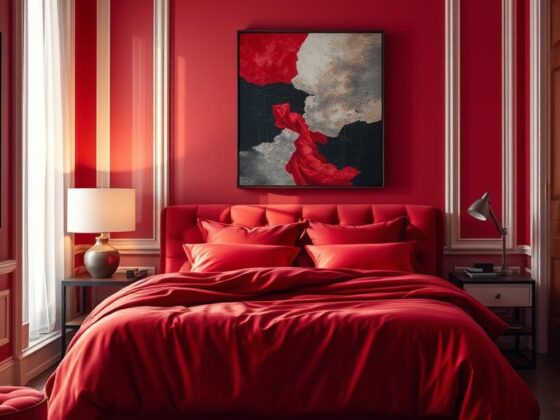
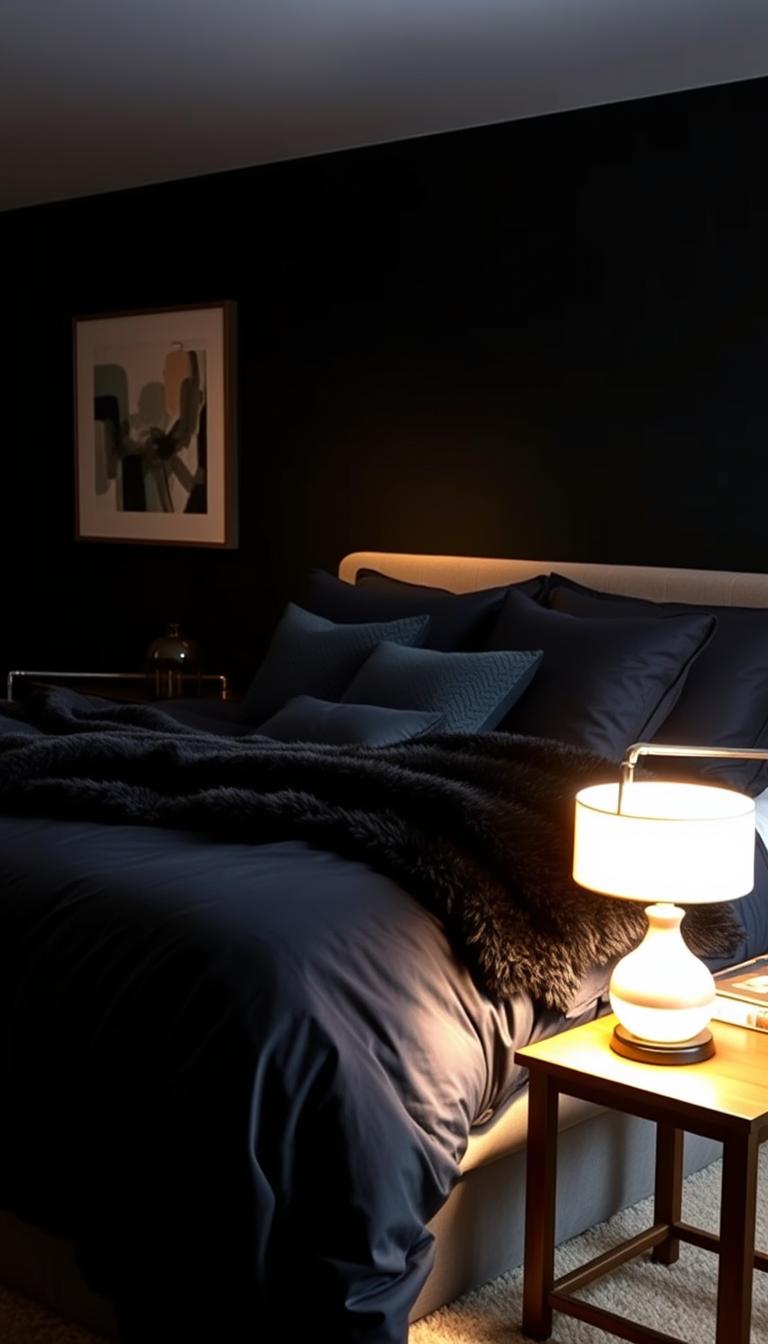
Curious how a deeper palette can make your bedroom feel calm and even bigger? I ask that question because many folks fear a heavy look, but handled right, tonality and texture create a serene retreat.
I help clients reshape their home sleep spaces with smart bedding swaps, layered lighting, and a tight color plan. When fixed elements like walls stay tonal and flexible layers shift, the room gains depth without feeling flat. Velvet, linen, and grasscloth add warmth and dimension while dimmers and sconces keep light balanced.
In this guide I’ll share quick, client-tested tips—from using a dark duvet as an anchor to placing pillows for contrast—so your design feels polished, personal, and restorative. Expect an easy checklist to change the look of your space without a full remodel.
Key Takeaways
- Layer light and texture to avoid a flat aesthetic.
- Use tonal walls plus flexible bedding for depth and balance.
- Choose fabrics like velvet and linen for instant warmth.
- Install dimmers and bedside sconces to control mood.
- Start with small swaps—duvet, pillows, and lighting—for big impact.
- Create a color plan that supports seasonal updates and longevity.
Why Dark Bedding Works: Benefits, Mood, and Present-Day Design Trends
A well-measured darker palette gently signals the brain to wind down. In my practice I see calmer nights when the eye meets steady tones instead of constant contrast.
Calming palettes and the science of a darker sleep space
Fewer color jumps makes the brain relax. When bedrooms carry a consistent saturation, the space reads as one calm field. That steady visual flow helps people fall asleep faster and sleep more deeply.
Color drenching—letting walls and floors live in the same tonal family—creates perceived depth. A dark bedroom can feel larger because darker surfaces recede visually, especially when balanced with controlled natural light.
Modern aesthetics: from color-drenched rooms to monochrome serenity
Monochrome styling is intentionally simple. It isn’t about all-black; it’s about limited tones and layered texture so the room still feels warm.
“In practice, I treat bedding and accents as flexible layers — swap textures seasonally without changing the room’s core style.”
- Use dimmers on bedside sconces to support circadian rhythm.
- Add one reflective element — a mirror or metal — to bounce light and keep the look lively.
- Start with a black headboard or single wall if you want a modern edge before committing fully.
Dark Bedding Ideas: Quick Wins You Can Try First
Begin with the bed and let the rest of the room follow. Small swaps let you test a bolder look without a full redo. I often use fabric and texture to anchor the scheme before changing walls or floors.
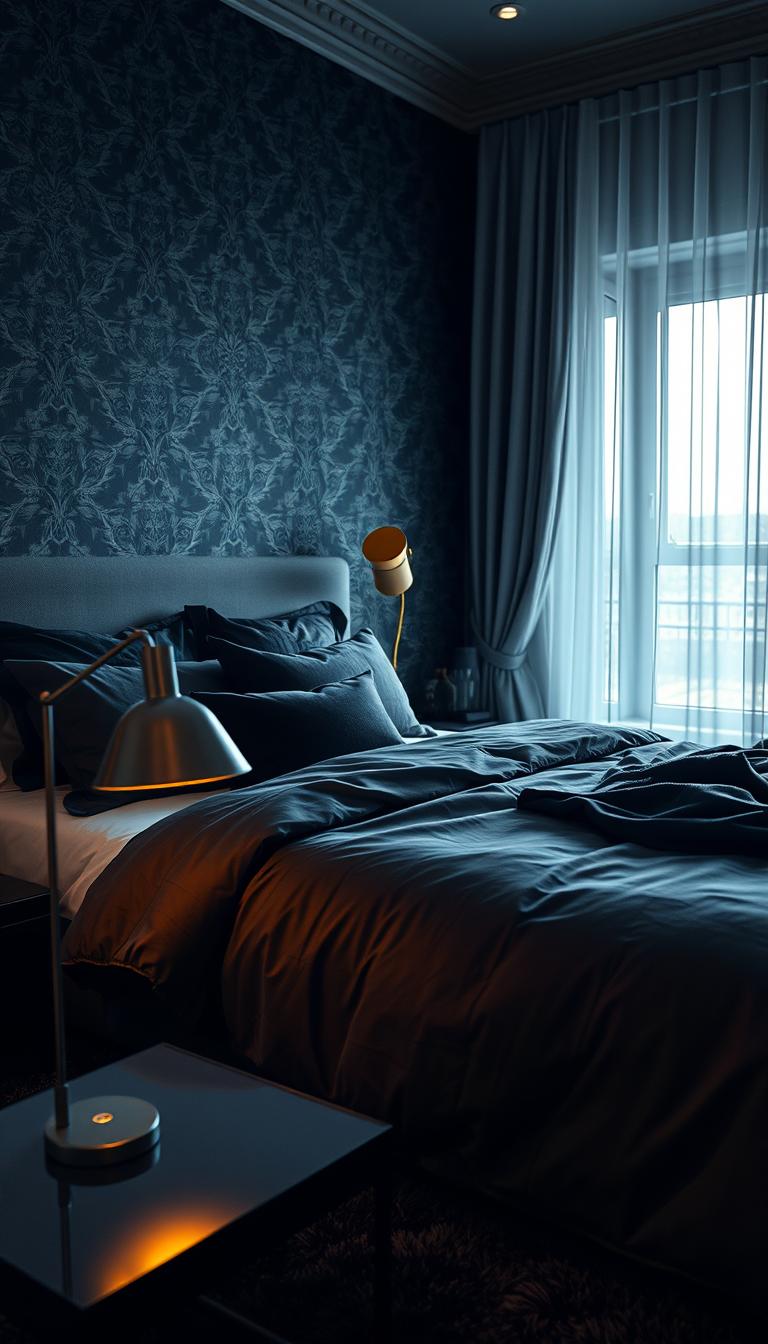
Swap in a dark duvet or comforter as a focal point
Start by switching the duvet. A deeper cover instantly becomes the focal point and gives the bedroom a grounded center. For tight spaces, keep nightstands and rugs lighter so the room feels balanced.
Layer white bedding with dark pillows for instant contrast
Pair white bedding sheets with darker pillows for an airy yet edited look. That contrast keeps a small space from feeling heavy and preserves breathability.
Use a textured throw to test deeper tones without repainting walls
Add a ribbed or knit throw to trial moodier shades. Textured weaves hide lint and feel lived-in. Repeat the new accent twice more—tray, frame, or lamp—so the update reads intentional.
- Mix matte and slight sheen—percale with sateen—to keep light moving.
- Choose a reversible duvet for two looks in one.
- Pick washable covers and zippered shams for easy refreshes.
“Texture and small repeats make a bold change feel polished, not overwhelming.”
| Swap | Why it works | Best for | Quick tip |
|---|---|---|---|
| Dark duvet | Creates a focal point without paint | All bedroom sizes | Choose charcoal over jet black for less lint visibility |
| White sheets + dark pillows | Keeps airiness while adding contrast | Small or compact spaces | Use two matching accent pillows for balance |
| Textured throw | Tests color and adds depth | Rentals or seasonal swaps | Repeat color in one accessory elsewhere |
Build Your Palette: Black, Charcoal, Navy, and Forest Green
Picking the right deep shade changes everything—subtle undertones make a room feel lived-in, not severe. I always test samples in morning and evening light before committing. Light reveals whether a hue leans blue, brown, or green.
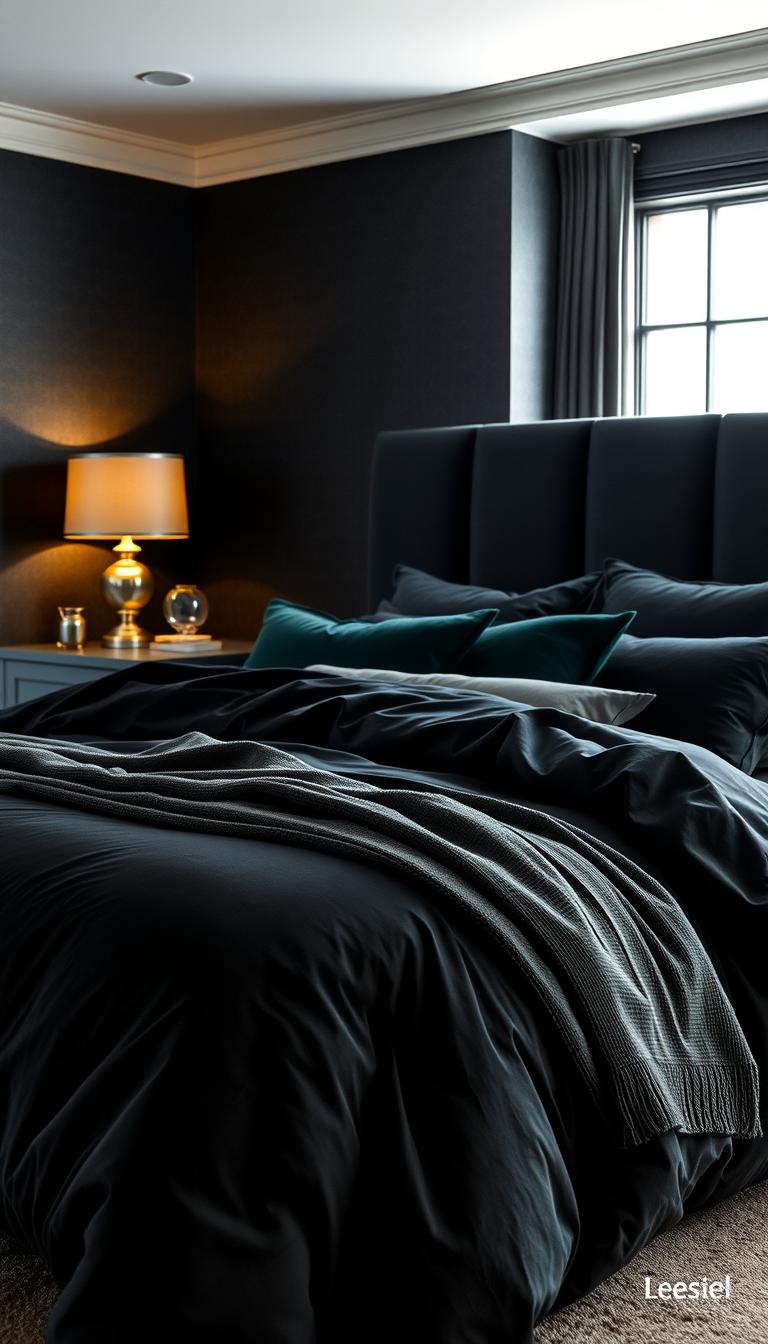
Choosing undertones and saturation for a cohesive look
Black isn’t one-size-fits-all. Softer blacks with gray or navy undertones read warmer and more livable.
I test swatches on the bed and the wall—then live with them for a day. That quick habit saves a late-night repaint.
Balancing dark walls with bedding versus accent walls
If you’re curious about black walls, start with one—the headboard wall is ideal. Echo that shade in textiles and art to make the choice feel intentional.
- Charcoal with a blue cast behaves differently than charcoal with brown—watch both at sunrise and after sunset.
- Navy and forest green bring a nature-like hush; pair them with walnut and brushed brass for warmth and subtle contrast.
- Keep saturation consistent across walls and large textiles so the palette reads calm.
“Sample large swatches and drape fabric over the bed — you’ll see how colors change when you move around the room.”
Choose a core family—cool or warm—and stick with it. That simple rule keeps your design coherent and the colors working together.
Layering and Texture: The Secret to a Cozy Dark Bedroom
Texture is what keeps deep palettes from going flat—it’s the visual and tactile glue of a room. I use it first when I want the bed to feel inviting and calm.
Mixing matte, velvet, linen, and knit brings contrast without adding pattern. A velvet cushion catches light. Linen shams read relaxed. A ribbed throw adds motion.

Mix matte, velvet, linen, and knit textures for depth
Start with two to three tactile contrasts on the bedding so the layout looks purposeful, not fussy. Balance sheen and matte—velvet reflects while cotton grounds.
Monochrome done right: letting texture be the “pattern”
In a monotone scheme, textures act as the pattern. Use oversized euros for height and standard pillows for sleep. Add a medium-tone quilt if the backdrop feels too severe.
“Tactile variety soothes; it signals that the bedroom is a place to rest.”
| Element | Effect | Best use | Quick tip |
|---|---|---|---|
| Velvet cushion | Reflects light, adds luxe depth | Accent pillows, benches | Use sparingly to avoid sheen overload |
| Linen shams | Breathable texture, relaxed look | All seasons | Choose warm neutrals for added warmth |
| Ribbed throw | Creates movement without pattern | Foot of bed | Repeat on an ottoman to unify |
| Matte duvet | Provides a calm backdrop | Base layer | Pair with one velvet cushion for balance |
Material Matters: Linen, Hemp, Velvet, and Cotton Sateen
Fabrics set the tone more than paint—what you sleep on shapes how the room feels. I start with materials when I plan a restful, lived-in look. Small swaps teach you what to keep and what to change.

Linen and hemp for breathable warmth
I reach for linen and hemp when clients want breathable warmth with a relaxed hand. Both soften over time, and pre-washed options resist shrinkage while getting comfier.
Hemp holds color richly—earthy green and charcoal options feel grounded and cottagecore-friendly. If you sleep hot, put these fibers next to skin and reserve heavier pieces for layers.
Velvet and cotton sateen for dimension and sheen
A velvet headboard or bench introduces luxe depth without overwhelming the bed. Use velvet for accents—pillows or a throw—so the finish reads intentional, not heavy.
Cotton sateen adds a soft sheen underneath a matte duvet. Mixing finishes—washed linen with sateen pillowcases—balances crisp and cozy on one bed.
“Test drape and weight: heavier quilts feel hugging; lighter coverlets ease seasonal transitions.”
- Practical tip: Choose zipper or envelope closures to streamline daily bed making.
- Treat velvet with a soft brush and rotate pillows to even wear.
Light It Right: Layered Lighting That Flatters Dark Palettes
Layered light transforms deep palettes from brooding to beautifully lived-in. I always start by mapping three roles for every fixture: overall glow, task-level clarity, and small accents that shape mood.
Ambient, task, and accent lighting for depth and warmth
Ambient pieces—think a low-profile chandelier or a soft pendant—give the room an even wash. They set the baseline so darker tones read calm, not cavernous.
Task lamps at the bedside must be bright enough for reading but soft at night. I prefer adjustable arms and two-point control so you don’t cross the space to switch lights.
Accent lighting sculpts texture—picture a wall wash, a picture light, or a small uplight behind a headboard. These small spots add dimension without raising overall brightness.
Dimmer-friendly sconces, candles, and sculptural pendants
Use dimmers on sconces and lamps to move from bright to calm as evening unfolds. Warm bulbs (2700K–3000K) flatter skin and deepen the cozy factor in bedrooms.
Candles, string lights, and rechargeable lanterns add ritual and softness. And a sculptural pendant can serve as jewelry above the bed—practical and pretty.
“Soft diffusion—fabric shades or frosted glass—keeps glare low and sleepy eyes happy.”
- I design lighting in layers—ambient, task at the bedside, and accent to sculpt the space.
- Bounce light off ceilings and walls to spread brightness evenly in darker palettes.
- Match metal finishes—brushed brass or matte black—to other accents for a cohesive design.
Accents That Shine: Metals, Wood, Stone, and Ceramic Finishes
I often let a single standout piece set the tone for the whole bedroom. Small finishes do heavy lifting—metal, stone, and wood create a layered, lived-in look without fuss.
Matte black meets brushed brass for subtle glow
Matte black paired with brushed brass gives instant glow without being flashy. I love the tension—it’s quiet, yet it reads as intentional.

Walnut and oak to add organic warmth
Walnut nightstands or an oak frame bring real warmth against a black wall. Those wood tones anchor charcoal textiles and keep the room from feeling flat.
Travertine benches and ceramic lamps for earthy balance
A travertine bench at the foot of the bed works as sculpture and storage. Ceramic lamps add a handmade softness—the slight irregularity makes the whole scheme feel curated.
- Limit metal finishes to one or two families so accents look curated, not chaotic.
- Repeat wood in frames or a small tray to stitch the story across the room.
- Choose supporting colors like beige, clay, or moss to bridge hard surfaces and soft textiles.
“One well-chosen piece—a vintage brass sconce or stone nightstand—can carry an entire vignette.”
Throws, Pillows, and Tapestries: High-Impact, Low-Commitment Updates
Small textile swaps are the fastest way to alter a room’s mood without a full overhaul. I use a handful of soft pieces to test a new style before I change anything permanent.
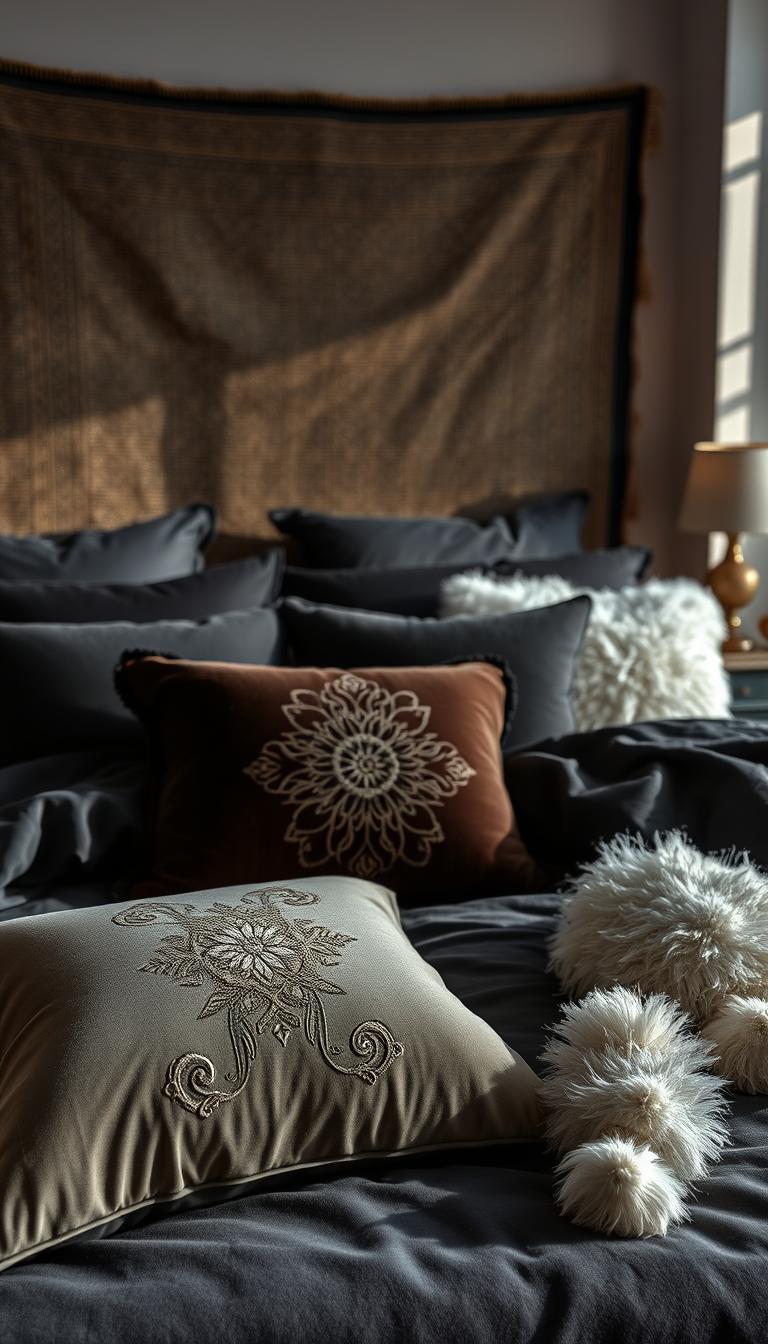
I rotate throws and pillows by season—mossy greens for fall, moody florals in winter, and celestial motifs when I want a night-sky vibe. Tapestries can drape a four-poster or hang as a lightweight headboard to shift the look instantly.
Seasonal swaps: mossy greens, moody florals, and celestial motifs
Quick rules I follow:
- Keep the duvet quiet if you’re pattern-shy; let pillows tell the story.
- Layer one long lumbar with two standards for proportion and comfort on the bed.
- Use an accent throw to bridge rug and bedding so the vignette reads cohesive.
- Choose washable covers—these pieces should be practical for daily life.
- Store rotated items in a basket for fast swaps and easy care.
- Snap a before-and-after photo to see which ideas really land.
“A single tapestry or mushroom cushion can rewrite a room without repainting.”
Aesthetic Spotlight: Dark Cottagecore Bedding and Decor
I love how woodland prints make a bed feel like a small, lived-in story rather than a staged set. This aesthetic leans into moody naturals—wildflower florals, mushroom motifs, and inky botanicals—to give a room narrative and calm.

Linen and hemp work beautifully here. They soften with use, breathe well, and read honest in forest green or muted florals.
Shop small when you can. Independent makers often use sustainable fibers and deliver better craftsmanship. A single tapestry above the headboard anchors the theme without repainting the whole home.
- Limit the palette to two or three hues so motifs feel romantic, not busy.
- Pair one rugged accent—stone or wood—with softer accents like ruffles or fringe for balance.
- Keep nightstands simple; let the bed lead while ceramics or dried stems echo the woodland mood.
“A nature-led vignette reads intentional when textures and small repeats tell the story.”
| Element | Why it works | Best for | Quick tip |
|---|---|---|---|
| Linen duvet | Breathable, lived-in warmth | All seasons | Choose pre-washed linen for softness |
| Mushroom cushion | Playful motif, tactile detail | Accent pillows | Pair with a plain lumbar to avoid clutter |
| Woodland tapestry | Anchors the theme without paint | Rentals and seasonal swaps | Frame or hang above headboard for focus |
Walls, Ceilings, and Windows: Framing Your Dark Bedding
The way you treat the edges of a room—walls, ceiling, and windows—sets the stage for every textile choice. Small moves here change how deep tones read and how the bed functions as a focal point.

Matte black accent wall versus full color drenching
If you’re not ready to drench, start with a matte black wall behind the headboard. A single paneled accent wall creates depth without overwhelming the space.
Full color drenching—walls and trim in one hue—delivers a seamless backdrop that feels intentional and modern. It’s a bold move, but it reads like careful design when paired with layered textiles.
Painting the ceiling to build a cocoon
Paint the ceiling darker to drop the visual lid and make the room feel cocoon-like. For tall rooms, a dark ceiling grounds a high canopy bed.
In lower rooms, keep the ceiling lighter so the space still lifts. Match sheen to intent—matte hides flaws; satin cleans easier if you need washability.
Black-framed windows and mirrors to reflect natural light
Black-framed windows and a large mirror add clean architectural lines and push natural light deeper into the bed area. These reflections enlarge the feel of the space.
Keep window treatments simple—beige linen or warm gray—to soften edges without stealing attention. Repeat the wall color in two small accents—lamp shade or frame—so the plan feels deliberate.
- Quick starter: matte black behind the headboard to make the bed the focal point.
- For cohesion, align casing and trim choices with the wall plan—consistency is half the magic.
- For upkeep: satin sheen on high-traffic surfaces; matte for a velvet-like backdrop.
Want more setups that work with this approach? See a gallery of successful rooms and finishes at stunning bedroom examples.
Small Spaces, Big Impact: Make Compact Bedrooms Feel Larger
Tight rooms don’t need timid styling—strategic contrast and scaled furniture change everything. I use a few reliable moves to stretch a small bedroom visually and functionally.
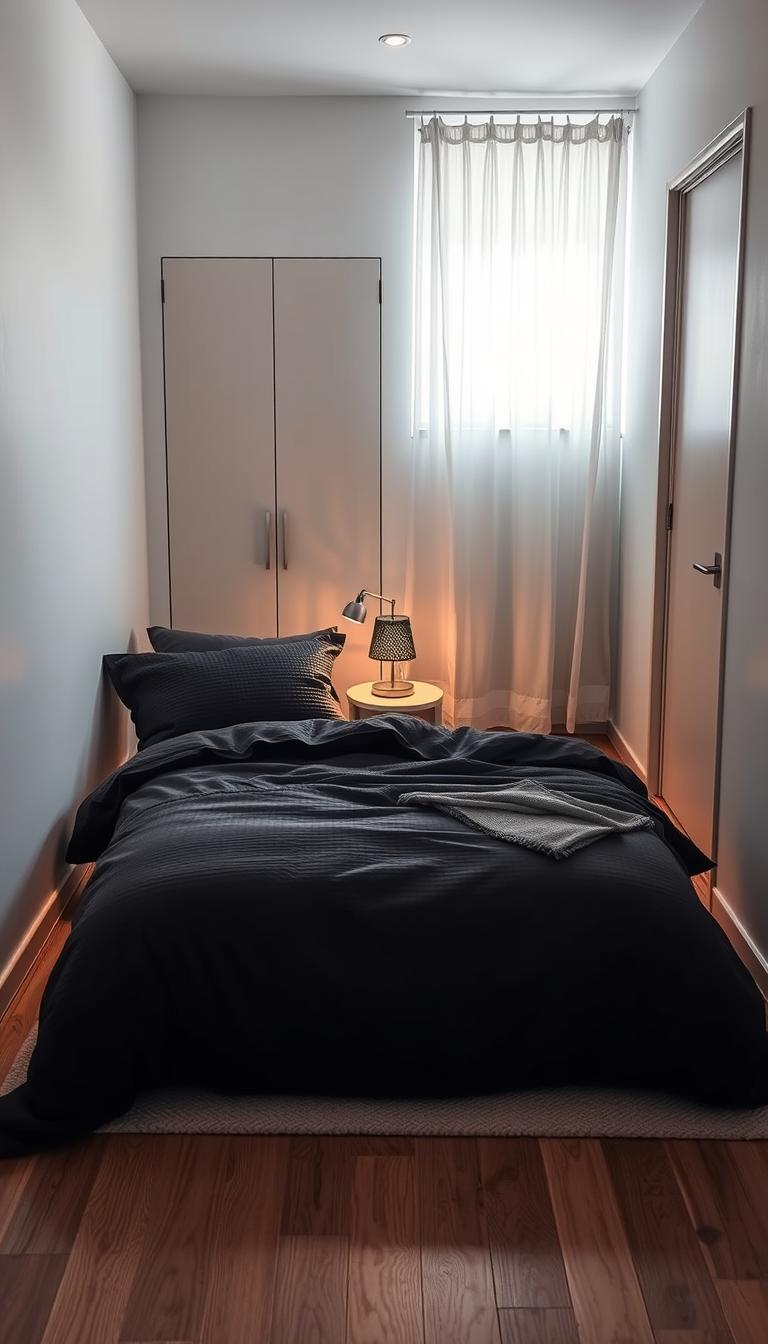
Use contrast with white bedding and sheer curtains
White bedding reads crisp against matte walls and gives the eye a place to rest. In my projects, a clean duvet plus sheer curtains invites natural light while keeping privacy.
Sheers blur the edge between inside and out. The result: a lighter, airier look without losing warmth.
Strategic mirrors, low-profile beds, and tidy built-ins
A single large mirror expands views and doubles light. I often specify a low-profile bed to increase perceived headroom.
Built-ins in matte cabinetry keep clutter hidden and create clean lines. Add subtle LED reveals and brass sconces to bounce light into corners.
“Contrast and storage are the small-room superpowers—use both and the space will feel intentional, not cramped.”
- Keep legs visible—floating visuals feel lighter.
- Edit nightstands to a drawer and shelf—small footprint, big function.
- Use vertical storage—hooks, slim shelves, and narrow ledges free floor space.
- Repeat two colors and one metal for a cohesive look.
| Strategy | Why it works | Best use | Quick tip |
|---|---|---|---|
| White bedding | Creates contrast and a bright focal point | Small bedrooms | Pair with sheer curtains for soft light |
| Large mirror | Reflects light and doubles perceived space | Narrow rooms or alcoves | Choose a black-framed option for crisp lines |
| Built-in storage | Reduces clutter and tightens sightlines | Closetless rooms | Include LED strips to highlight shelves |
Styling Playbook: Balance, Contrast, and Finishing Touches
You can balance strong tones with a few thoughtful accents and simple swaps. I use flexible elements—bedding, accents, and art—to shift mood without repainting or a full redo.
Mixing flexible elements: bedding, accents, and art
Start with repeat. I repeat each color at least twice so the eye connects the room. Treat pillows, throws, and art as mixable pieces you can rotate seasonally.
One sculptural lighting piece can act like jewelry over the bed and make the whole vignette feel finished.
When to add white bedding, beige linen curtains, or greenery
White bedding is my quick reset when the palette feels heavy; contrast returns instantly and calms the view.
Beige linen curtains warm dark walls and filter daylight into a soft glow. Add a single plant for life—deep green leaves read like a tiny spotlight against richer tones.
- Repeat each color twice to build visual balance.
- Treat art and accents as interchangeable pieces.
- Limit your palette and add nuance via materials, not more colors.
- Photograph the bed wall when unsure—the camera shows balance issues fast.
- Keep lighting layered so the mood can shift from task to calm.
“A sentimental piece—one framed photo or heirloom—makes a styled room feel like yours.”
Conclusion
Finish strong by remembering the three pillars: backdrop, lighting, and touchable texture.
I recommend a calm backdrop—one matte black wall or a deep, even color—to set the stage. Then layer warm wood accents and a few velvet touches to add richness and softness.
Treat lighting as a system: ambient, task, and accent. That lets the bed become the focal point and keeps the room flexible for day and night.
Whether you’re starting with one dark bedroom idea or testing a new duvet, small, intentional swaps add up fast. Repeat colors and finishes in two places to knit the look together and keep the space feeling larger.
If you take one thing with you, let it be this: a calm backdrop, layered lighting, and tactile layers are the backbone of successful dark bedroom ideas. Edit with heart—and enjoy the warmth your choices bring.